Relievas ad: Katelyn Perales
Relievas
🇺🇸
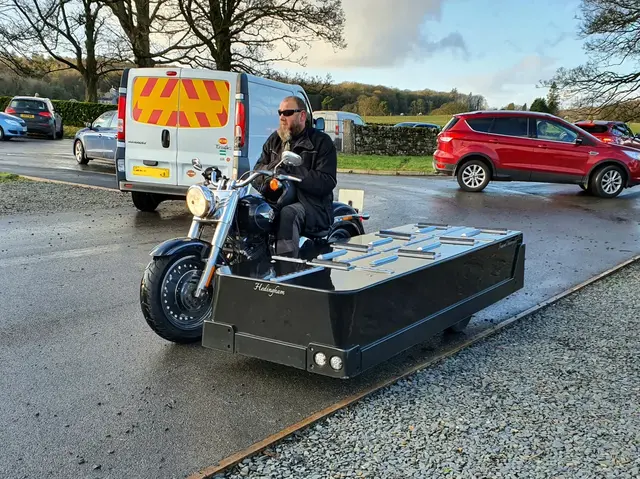
I sat in my pickup truck and watched my best friend's funeral procession ride past me. 42 motorcycles. I should have been the second one back. I drove the F-150 instead. And what happened three weeks after that funeral is the only reason I'm writing this. Because if Ray hadn't died — if Frank hadn't been at that wake — I'd still be sitting on my back porch listening to other men ride past my house on Sunday mornings. I want to say something to every man my age who's quietly given up on something he loved. Because I almost did. I bought my first Harley in 1991. A Sportster. Used. Broke down on me twice the first month. I didn't care. I rode it to work every day from April to October for fourteen years. I rode to the Black Hills every August. 24 years in a row. Ray and me and four other guys — we'd leave from the diner at 5am on the second Saturday and we'd be in Sturgis by Tuesday afternoon. 24 years. That's not a hobby. That's who I was. I ran a small machine shop. Retired four years ago. The day after I retired I bought a 2018 Road King. Black on black. The bike I'd been promising myself for 30 years. I rode it home from the dealership and pulled into the driveway and my wife came out and said, “well there he is.” She meant it nicely. I knew what she meant. The plan was simple. Retire. Ride. Take the grandkids out on Saturdays when they got old enough. Do the Black Hills run with Ray every summer until one of us couldn't. That was the plan. The first time I noticed something was wrong I was getting off the bike in my own driveway. Saturday morning. October. I'd just come back from a 90-minute ride. I swung my right leg over the saddle and the knee buckled the second my boot hit the concrete. I caught myself on the seat. Almost dropped the bike on top of me. I just stood there with one hand on the seat looking down at my own leg like it belonged to somebody else. I shook it out. Walked it off. It loosened up after about 20 minutes. I told myself it was just a long ride. Cold morning. I was 58. These things happen. But it kept happening. It happened the next Saturday. Then the Saturday after that. Then it started happening on weekday mornings before I'd even ridden anywhere. I'd wake up at 6am and my right knee would be so locked up I couldn't put weight on it for the first ten minutes of the day. I'd swing it off the side of the bed and let it dangle and rotate the ankle and wait for the joint to remember how to be a joint. The inside of the knee felt like there was gravel in it. I started sitting down on the edge of the tub to put my pants on. I never told anyone I was doing that. It felt like an old man thing to do. I was 59. By the next spring it was bad. I'd pull up to a red light on the morning ride and put my right boot down and the knee wouldn't lock to hold the bike up. I started taking corners wider so I wouldn't have to lean as hard. I started leaning the bike onto the kickstand at gas stations instead of straddling it. The boys started noticing. Ray pulled up next to me at a gas station outside Mansfield and watched me dismount. He said, “you alright over there?” I said yeah. Just stiff from the ride. He looked at me for a long second. He didn't say anything else. But I knew he knew. I went to my GP. He bent the knee. Listened to it crackle. Pressed on the inside of it until I winced. He said the words I'd been dreading. “Looks like osteoarthritis of the knee. Medial compartment. Pretty common in guys who stood on concrete their whole working life.” He prescribed Meloxicam. I took it for six months. It helped a little. It also gave me an ulcer. I had to stop. Then I started the parade. Don't laugh. You probably did the same parade. I tried over-the-counter ibuprofen. Three a day. Stomach turned to acid in two weeks. I tried a neoprene compression sleeve from CVS. Felt better wearing it but I couldn't ride with it on under my jeans for more than an hour without my whole leg going numb. And when I took it off the joint had gotten weaker. So that was a wash. I tried a cortisone shot. The orthopedic guy stuck a needle right into the joint space. Hurt like hell. But for about three weeks I felt 25 years old. Then it wore off. He said I could get one more, maybe two, but cortisone breaks down cartilage long term. He said, “you don't want to be doing these every six weeks.” I tried Synvisc. The gel injections. Three rounds. $1,200 my insurance didn't cover. Maybe six weeks of mild relief. Then back to baseline. I tried glucosamine and chondroitin. The big bottle from Costco. Took it religiously for four months. Maybe a tiny difference. Hard to say. I tried turmeric capsules because my niece swore by them. Nothing I could feel. I tried CBD oil — both the rub and the gummies. Spent like $180 on a tube of the rub because my buddy said it was “the real stuff.” Nothing. I tried a hinged knee brace from Amazon. Heat pads. Ice baths. A TENS machine I bought for $89. Nothing. Nothing. Nothing. I'd seen the Amla ads. I'd scrolled past them a hundred times. Every time I saw one I'd say the same thing out loud: “what a load of garbage.” Amla was something people put in green powders. Something from a health store shelf. Some sour fruit from India that wellness people talked about online. Snake oil for old people who'd given up. Not me. I was a machinist. I worked with metal for 35 years. I understood pressure, flow, friction, wear, and breakdown. A berry was not going to help a knee. That is what I thought. I would never have bought it. Not in a million years. By the time I was 61 I was not riding anymore. Not really. I'd take the bike out of the garage on Sundays and ride for 20 minutes around the block to keep the battery up. Then I'd put it back. I missed the Black Hills run that summer. First time in 25 years. I told the guys it was because my wife had a thing. She didn't have a thing. I just couldn't hold a 750 pound bike up on one leg at gas station stops for 18 hours a day. I cried in the garage that Saturday morning while everyone else left at 5am. I don't tell people that. I haven't told my wife. I'm telling you because I think there's somebody reading this who's done the same thing. Sat in your garage on the morning your boys left without you. I listed the Road King on Marketplace twice. Both times I took it down before anybody messaged me. I couldn't bring myself to sell it. But I couldn't ride it either. So it sat there. Eight thousand miles on a 2018. You don't see that on a bike that belongs to a man who's been riding for 30 years. That bike was a tombstone in my garage. And then in November Ray died. Heart attack. He was 64. He was on his bike when it happened. Pulled over to the shoulder of Route 30. Made the call to 911 himself. Was gone before the EMTs got there. The boys planned the procession for the funeral. 42 bikes. From the funeral home to the cemetery. 90 minutes through three towns. I was supposed to be second back, behind Ray's son. The night before the funeral I sat on the Road King in my garage and tried to hold it upright with just my right leg. I couldn't. After 10 seconds my knee was shaking and I had to drop the kickstand or lose the bike. I drove the F-150 to the funeral. I parked it on the side of the road outside the cemetery and I sat there and I watched 41 bikes ride past me. 41 because mine was the missing one. I cried in that truck. For Ray. For me. For the man I used to be who was dead too — just nobody had buried him yet. After the service there's a wake at the VFW. I'm standing in the corner with a cup of coffee, my weight shifted onto my left leg. A guy walks up to me. Big guy. Beard. Late 50s. Riding gear under his suit jacket. He sticks out his hand. “Frank Kowalski. I rode with Ray's brother in the 90s.” I shake his hand. I notice the bottle he sets next to his coffee. Small white bottle. Green label. Relievas. Amla. I notice it the way you notice things you've been dismissing your whole life. He sees me notice. He says, “you're Mike, right? Ray told me about you. Said you were having knee trouble.” I say yeah. He says, “what kind?” I tell him. Medial compartment. Bone on bone now. He nods. He glances down at how I'm standing. He says, “I'm an orthopedic surgeon. I work out of the orthopedic group on East Main. You should come see me Monday.” He hands me a card. I'm thinking great. Another guy who's going to tell me about cortisone or knee replacement. I almost throw the card away in the parking lot. I don't know why I didn't. Monday morning I'm sitting in Frank's exam room. He's not in scrubs. He's in jeans and a flannel. He looks at my knee for about two minutes. Bends it. Listens to it grind. Watches me stand up out of the chair and sit back down three times. He sits down across from me. He says, “alright. Let me tell you what I'd tell my own brother.” He held up one finger. “You have stage 3 osteoarthritis. Medial compartment. Bone on bone. 30 years of standing on concrete and gripping a bike with your knees. The cartilage is gone. It's not coming back.” I felt my stomach drop. Then he held up a second finger. “Replacement is an option. I'd do it if I thought it was your best option. But I'm going to tell you something most surgeons won't. For guys like you — riders, guys who use their legs hard — a knee replacement trades a known pain for an unknown outcome. About 60% of riders I've operated on say they wish they'd waited. The flexion after a replacement is permanently reduced. You lose 10 to 15 degrees of bend. You can't kneel the same way. You can't swing your leg over a saddle the same way. You wouldn't be back on a Road King doing 18 hour days. Not the same way. So if you're asking me, I'm telling you I'd do it last. Not first.” I said okay. Then he held up a third finger. He said, “the next thing I'm going to tell you most doctors won't say. Most doctors won't say it because they can't bill for it and they can't prove every piece of it in one clean study yet. But I've been an orthopedic surgeon for 23 years. And I've watched too many of my patients walk out of here, dismiss my advice, and come back six months later with less stiffness than I expected. So I track what works.” He picked up the little bottle from his desk. The same one I saw at the wake. Relievas. Pharmaceutical-grade Amla capsules. “This is mine,” he said. “I've been taking it every morning for three years. And I tell every single one of my OA patients about this pathway. Not because I sell it. I don't. Not because it's magic. It isn't. But because the pattern I see — my own patients, hundreds of them — is too consistent to ignore.” I just stared at him. Then I said the thing I'd been thinking the second he held up the bottle. “Frank. My problem is in my knee. Not my stomach.” He smiled. He said, “I was waiting for that. Every patient I show this to says the same thing. Sit back. This is the part everybody misses.” He drew a circle on his notepad. “Your knee is inflamed. Chronic, low-grade inflammation. The cartilage is gone. Every time you put weight on it — standing up, walking down stairs, holding the bike up at a stoplight — bone rubs on bone, the inflammation goes up, the joint stiffens, you lose more range of motion, and you compensate with the other leg. Which makes the inflammation worse on both sides.” He tapped the circle. “Cycle. It feeds itself. That's what you've been living in for four years.” He continued. “Your pills. Meloxicam. Ibuprofen. Those work by blocking the chemical signal of inflammation. They don't help your body clean up the mess inside the tissue. They mute the alarm. They don't put out the fire. And they trash your gut and your kidneys doing it.” I thought about my ulcer. “The compression sleeve. It immobilizes the joint, which gives the inflammation a chance to drop. But it also makes the muscles around it weaker, so when you take it off you're worse than before. And you can't wear it under jeans for 18 hours on a bike.” I nodded. “The cortisone. Cortisone is a hammer. It crushes inflammation for three weeks. Then it wears off and the joint comes back angry. And the cortisone itself can speed up cartilage breakdown. I do them. I do them sparingly. They are not a long-term solution.” He paused. “The Synvisc. That's mechanical. It cushions the joint for a few weeks. It doesn't touch the larger inflammation cycle. The body breaks it down and you're back where you started in two months. $1,200 a round and they want to sell you the next one before the last one fails.” He looked at me. “The supplements — glucosamine, turmeric, CBD. There's some signal in the literature. Tiny effect for some people. Months to feel it if at all. None of them were doing enough for you.” He looked at me harder. “Everything you've tried addresses one piece of this cycle. Or zero. None of them break it. So the inflammation keeps cycling. The tissue stays stressed. The leg keeps weakening. And four years go by.” I sat there. I had nothing to say. Because I'd just heard the first explanation in five years that actually made sense. I asked the question again. “So how does Amla in my stomach help my knee?” He smiled. Like he'd been waiting for it. He said, “I'll give you the honest answer. Three things are probably happening. Maybe one. Maybe all three. The science isn't settled on every detail and I'm not going to lie to you and pretend it is.” He held up one finger. “This is the thing every patient misses. Amla is not topical. It's not a cream. It's not a bandaid that works where you rub it. You swallow it. It goes through digestion. Then its key compounds move through your bloodstream. From your bloodstream it goes everywhere. To your knee. To my shoulder. To your other knee. It's systemic, not local. The stomach is the entry point. Not the treatment target.” He held up two fingers. “Amla is rich in emblicanins. Those are strong plant compounds. They help protect your cells from oxidative stress. And oxidative stress is one of the things that keeps low-grade inflammation alive. When the body is under less stress, the inflammation signal can calm down. Modest. Real. Measurable in some patients on bloodwork.” Three fingers. “And circulation. This is the part most people miss. Amla supports the endothelium. That's the thin lining inside your blood vessels. That lining helps your body make nitric oxide. Nitric oxide tells blood vessels to relax and open. That's vasodilation. Blood vessel expansion. Better vessel function means more blood can reach damaged tissue. More oxygen. More nutrients. More waste cleared out. Knees included. There are studies. They're not magic. But they're not nothing.” He paused. “And honestly — there's probably a nervous system effect on top of it. And I want you to know I do not care. Because here's the thing every doctor learns and most won't say out loud. When pain starts to calm down, your nervous system stops guarding so hard. That's a real biological event. If better circulation and lower stress help your leg stop bracing all day, the cartilage doesn't care why. It just gets a break.” I laughed. First time in two months. He said, “I'm a surgeon. I trust what I can cut into. But I also trust 4,000 orthopedic patients telling me the same thing for 23 years. So when I have a guy like you — stage 3, riding, replacement is the wrong first step — I tell you to try this for three months before we talk about anything else.” I said, “but every Amla product I've ever seen looks like junk.” He said, “they are junk. 95% of them.” He opened his desk drawer. He pulled out a small bottle. He said, “the only one I've found that's worth a damn is this brand. Relievas. Pharmaceutical-grade Amla capsules. Most of the ones online are cheap fruit powder. They don't standardize the extract. They don't tell you the emblicanin content. They throw Amla in a blend with sixteen other things and call it heart support. This one is standardized Amla extract. Rich in emblicanins. Made to support nitric oxide, blood vessel expansion, circulation, and a healthier inflammation response. Clean formula. Third-party tested. No cheap blend.” He set it on the desk. The brand was called Relievas. I'd never heard of it. He said, “take it every day for three weeks. Don't skip. Then I want you to stop for one full day in week four and tell me what happens.” I asked why. He said, “because that's how you'll know if it's doing something. The stop test. If the stiffness comes back when you stop and eases when you start again, you have your answer. If nothing changes, send it back. They have a money-back guarantee. You're out the time it takes to mail it.” I ordered it from his office on my phone. Week one. Honestly? Not much. I kept waiting to feel something. I don't know what I was expecting. A rush. A tingle. Some big moment. Nothing. Maybe my knee felt slightly looser when I got out of bed. Maybe I was imagining it. I almost stopped twice. But Frank's voice was in my head. Three weeks. Don't judge it. So I kept taking it. Week two. Tuesday morning. 6am. I came down the stairs to make coffee. I came down facing forward. I'd been going down the stairs sideways for two years. I didn't even realize I'd done it until I got to the bottom and looked back up. I stood in the kitchen and I started crying. Because I'd forgotten that sideways wasn't a normal way to go down stairs. I'd forgotten what it felt like to walk down to my own coffee pot without thinking about every single step. It came back to me in that one second. My wife came in. Saw my face. She said, “what's wrong?” I pointed at the stairs. I said, “nothing. Nothing's wrong.” Week three. I went into the garage. I pulled the cover off the Road King. I swung my right leg over the saddle. It went. Smooth. No catching. No hesitation. No grimace. I sat on the bike with both feet on the ground and held it upright with just my right leg. I held it. 20 seconds. 30 seconds. A minute. It didn't buckle. I sat there in the garage on a bike I hadn't really ridden in 18 months and I realized I was shaking. I started it up. Took it down the driveway. Around the block. Came back. Got off the bike. Knee felt fine. Week four. I did the test. Saturday morning. I skipped the Amla. Left the bottle on my dresser. Drove to the lake with my wife. Spent the day fishing. By 2pm my right knee was locking up between casts. By 4pm I couldn't stand up out of the lawn chair without grabbing the cooler with both hands. We drove home. I took Relievas again at 6pm. By the next morning I was fine. That was the moment I knew. It wasn't placebo. Or — fine. Maybe it was. I don't care. It worked. That's all I care about. Week six. I rode the Saturday morning loop with the boys. Two hours. Three of the four guys are still alive. We rode past the cemetery where Ray is buried. I waved. Felt stupid. Did it anyway. When we pulled into the diner I swung my leg off the bike and I shook out my knee and it was fine. Tom looked at me from the next bike. He said, “you're back.” I just nodded. I couldn't say anything. Week eight. Two months ago last Tuesday. I rode to the Black Hills. I made the boys leave a day later than usual so I could go. Five days. Eighteen-hour ride days. My grandson rode behind me on the back seat for the first time. He's 14. His mom — my daughter — texted me a picture of us pulling out of the driveway at 5am. Two helmets. The Road King. The sun coming up. She wrote, “dad you look like you again.” I cried in a gas station in Iowa reading that text. I'm a 62 year old man crying in a Casey's at 9am. I don't care. I'm writing this six months after Ray's funeral. I took Relievas this morning. I haven't missed a day in 178 days except for that one day at the lake and a couple of times when I forgot it on trips. My knee is not perfect. The cartilage is still gone. I still have stiffness if I really push it. But I'm riding. I'm walking down stairs forward. I climbed a step ladder on Sunday to change a porch bulb. My wife was at the kitchen window. She just looked at me when I came down. She said, “well look at you.” I winked at her. I haven't winked at my wife in four years. I'm writing this because I almost gave up. I almost sold the Road King. I almost spent the rest of my riding years sitting on the porch listening to other men ride past. And the only reason I didn't is because Ray died and Frank was at the wake and I happened to take the card. I want there to be one less Mike in a pickup truck at his buddy's funeral procession. If you're reading this and your knee is the reason you're not riding anymore — or your shoulder is the reason you don't golf anymore — or your hip is the reason you don't garden anymore — I'm not telling you Amla is magic. I'm telling you this is what worked for me. And the worst case is you're out the time to mail it back. It's called Relievas. Pharmaceutical-grade Amla capsules. Standardized Amla extract. Rich in emblicanins. Made to support nitric oxide, vasodilation, blood vessel expansion, circulation, and a healthier inflammation response. Money-back guarantee. I checked. They actually honor it. Frank's patients have tested. Take it every day for three weeks before you decide. Then stop for a day in week four and see what your body tells you. That's the test. I'm not a doctor. I'm not a salesman. I'm a 62 year old retired machinist who almost gave up and didn't. Ray didn't get any more rides. I did. Don't sit in your truck while your buddies ride past. Don't list the bike on Marketplace twice and take it down twice. Don't tell yourself this is just what 60 looks like. Try the thing. Take it for three weeks. Stop for a day. Let your body tell you what your joints already know. I rode 1,400 miles last month. A year ago I couldn't hold a bike up at a red light. That's all I have to say.
Performance Signals
- Status
- Still running
- Time Running
- 102 days
- Active Period
- Jun 12, 2026 → Today
- First Seen
- Sep 30, 2026
Creative & Links
- Meta post ID
- 1743884003284968
- Meta page ID
- 1036410519555387
- Format
- Image
- Placements
- Facebook, Instagram, Audience Network, Messenger, Threads
- Country
- 🇺🇸 United States
- Landing Page
- relievas.com/products/amla-g
- Original Ad
- Open in Meta Ad Library
Relievas
relievas.comRelievas
Shop Infos
- Created
- Mar 31, 2017 · 9y 7m
- Category
- Nutrition › Vitamins & Supplements › Health
Search every indexed Meta ad by niche, format, country and run time, save creatives to boards and track the brands behind them — free, no card.