researching a product
Researching a Product: A Practical 2026 Guide
Researching a product means testing audience, demand, rivals, and positioning. Use this 2026 process to separate real buyers from ad noise.
Updated November 2, 2026

75% of consumers researched products online before buying them in physical stores, according to Bazaarvoice's 2024 Shopper Experience Index, which surveyed more than 8,000 consumers across seven countries, as reported in its survey announcement. The eventual purchase tells you where someone paid, not everything they checked before deciding.
For an ecommerce operator, researching a product means reconstructing that decision. Ads and traffic give you leads to investigate. A useful research file shows whether the offer solves a recognizable problem, whether shoppers can trust its details, and what evidence would justify testing it.
Table of Contents
- The Evidence File for One Product
- How to Research a Product in Six Moves
- Separate Real Demand from Paid Attention
- Where Shoppers Look Before They Buy
- Checks That Stop a Bad Product Call
- Save a Dated Verdict on One Store
The Evidence File for One Product
A file beats a hunch because you can challenge a recorded observation. You can't meaningfully challenge a feeling that a product looks promising.
The habit of investigating products is widespread. SQ Magazine's consumer-buying summary reports Eurostat's finding that 72% of EU residents aged 16 to 74 used the internet to find information about goods and services in 2025, alongside a separate global figure of 81% of online shoppers researching products before purchase.
Your task isn't to collect everything shoppers might encounter. It's to record enough evidence to explain a particular buying decision.
Build the working file
Use a spreadsheet, shared document, or research workspace. Give every observation a date, a page address, a country where relevant, and a separate field for your interpretation.
Four layers to fill before judging a product
| Layer | Question it answers | Evidence to collect | Weak signal to ignore |
|---|---|---|---|
| Audience | Who is this for and what job does it do? | Review language, customer questions, visitor countries | Follower counts or the vibe of an ad |
| Demand | Would people buy without a push? | Repeat mentions, full-price talk, organic discovery, returns complaints | A brief burst of heavy ads |
| Competitors | Who already sells this job? | Three to five direct stores, one substitute, price band, ad run length | A single bestseller screenshot |
| Positioning | Why does this offer win the comparison? | Claim, specification, delivered price, shipping, guarantee versus rivals | A slogan with no proof |
Audience means the buyer plus the job. For a compact air purifier, review language about fitting beside a bed is more useful than an advertiser's broad interest category. Record the customer's wording without turning it into a demographic guess.
Demand needs evidence of willingness to buy, not merely willingness to look. Leave this row unresolved when you have attention signals but no credible purchase evidence.
Compare the actual offer
Choose competitors that solve the same problem. A smaller purifier might compete with another compact model, but its substitute could be a different approach to bedroom air quality. Don't fill the competitor row with stores that merely share an aesthetic.
For positioning, compare what the customer receives and what the operator must spend. Keep the shopper's delivered price separate from your own landed inventory cost. Supply Automate's landed cost guide for DTC brands is a useful companion when building the cost side of that comparison.
Practical rule: Finish the evidence file for one product before opening another. Empty cells are questions to investigate, not invitations to browse more products.
Date every cell you change. This worksheet isn't a score that declares a winner. It's a record that lets you see which facts moved and which assumptions remain unsupported.
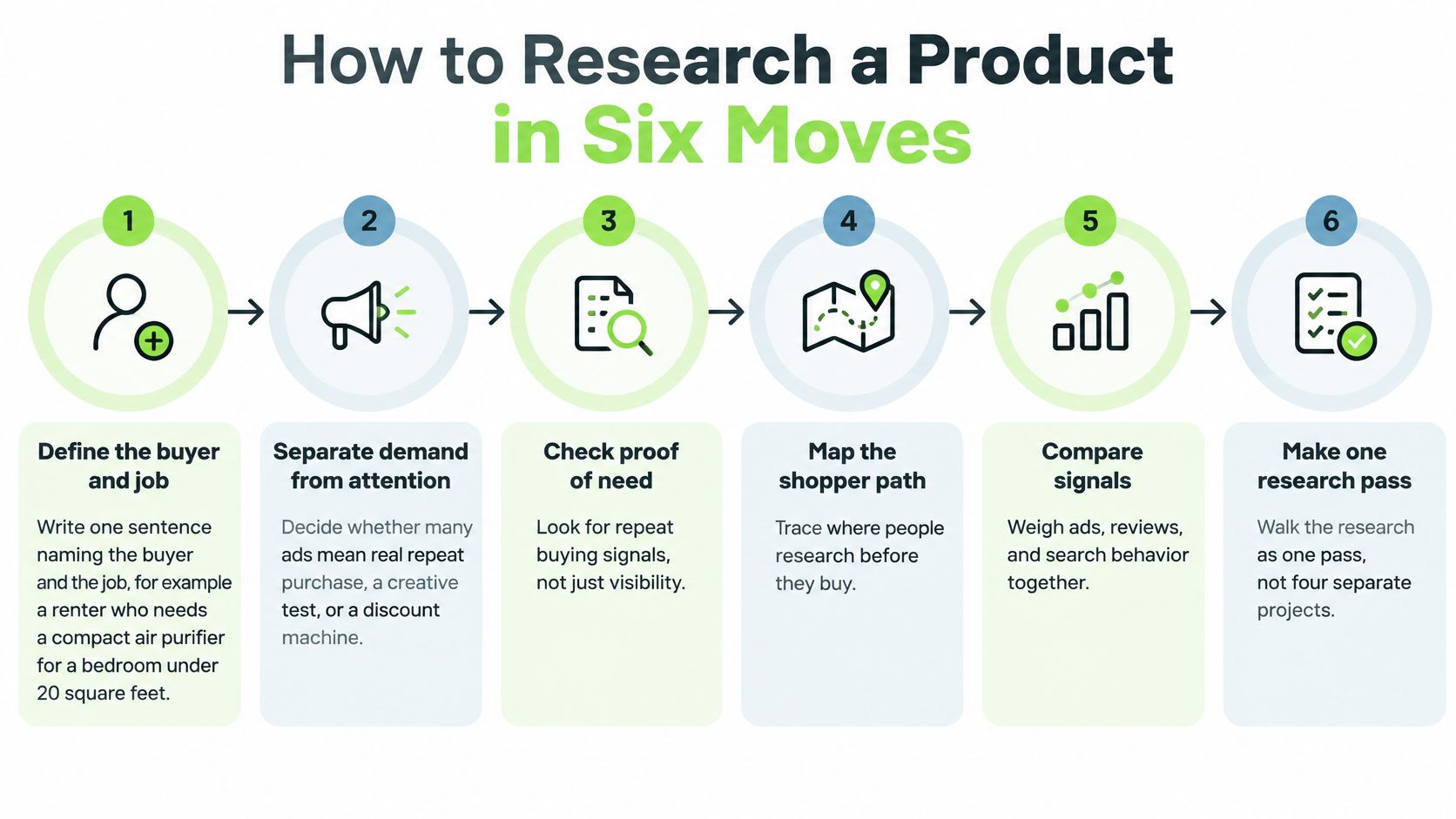
How to Research a Product in Six Moves
Researching a product works best as a connected pass. Keep the buyer, offer, competitor comparison, and task test in the same file so an appealing creative doesn't become detached from the product it promotes.
Use the visual as a reminder of the evidence checks, then work through the actions below.
Define and document
-
Write the buyer-and-job sentence.
Say a renter needs a compact air purifier that fits beside a bedroom nightstand and won't disturb sleep. That sentence gives you questions to investigate: footprint, noise settings, replacement filters, and usable controls. People who like clean air is too broad to guide a comparison. -
Set purchase tasks before judging the page.
Ask representative shoppers to establish the product's size, compare a meaningful specification, find the delivered cost, locate return conditions, and read the offer on mobile. Phrase tasks as goals, not directions. Find out whether it fits your space tests comprehension; click the dimensions tab tests whether someone follows instructions. -
Record the public offer without improving it.
Copy the price, variants, materials, included accessories, and availability into the file. Describe what the photographs demonstrate. If a purifier appears beside furniture but has no dimensions, record that gap rather than estimating measurements from the scene.
Compare and test
-
Map direct competitors and a substitute.
Compare each store's relevant range, not just its cheapest advertised item. Note whether an apparent price advantage disappears when you choose the equivalent capacity, accessory bundle, or warranty. This prevents an entry-level variant from making the whole offer look cheaper than it is. -
Log advertising as a testable proposition.
Capture the claim, landing page, advertised country, and observed run history. Write the hypothesis explicitly: shoppers may value quiet operation more than a decorative finish. Don't translate an active campaign into a sales estimate.If you're considering automation, Pazi's case for agent-led research provides context for delegating collection work. Keep responsibility for interpreting the evidence with the analyst.
-
Score comprehension rather than clicks.
Watch shoppers complete the tasks without coaching them. Record success, elapsed time, hesitation, and their stated reason for stopping. Put your verdict in a different column so an observation such as missed return restriction doesn't become product has no demand.
Nielsen Norman Group's ecommerce product-page research combines usability testing, diary studies, eye-tracking, and expert review across more than 350 websites. That breadth is a useful reminder: a page inspection and a customer task test answer different questions.
Benchmarks to score a product page against
The product-page benchmarks reported in that research provide context for the audit, not a pass mark for your product.
| Benchmark | Value | How to use it |
|---|---|---|
| Leading desktop sites with decent or better product-page UX | 48% | Check whether specifications, costs, and terms are understandable |
| Leading mobile sites with decent or better product-page UX | 38% | Check the mobile read first |
| Shoppers inferring product size from imagery | 42% | Treat a missing scale cue as a concrete comprehension risk |
A missing scale cue is evidence of an information problem, not proof that shoppers dislike the product. Correct the ambiguity before interpreting rejection.
Finish with a dated go, watch, or drop decision. Add the fact that would reverse it, such as shoppers understanding the size but still rejecting the offer at its intended delivered price.
Separate Real Demand from Paid Attention
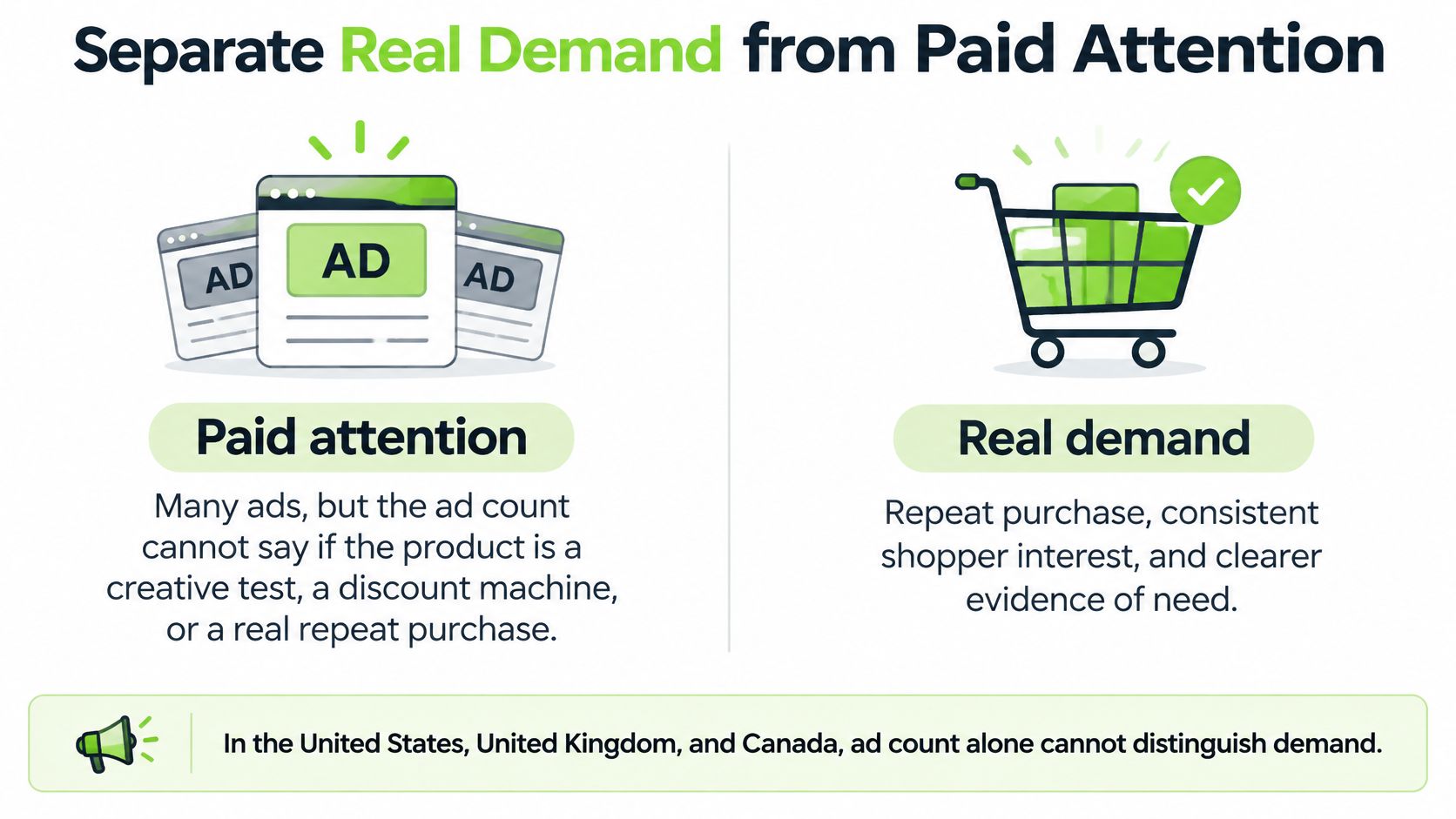
A product with many ads could be a creative test, a discount-dependent offer, or a genuine repeat purchase. The ad count cannot distinguish those possibilities. Neither can a busy store homepage.
The distinction is simple enough to keep beside your research file.
Salsify's consumer research found that shoppers in the United States, United Kingdom, and Canada discovered new products in physical stores at 60%, ahead of online marketplaces at 57% and social platforms at 52%. It also found that up to 45% of Gen Z and 43% of millennials abandon purchases when product details differ across websites.
That makes cross-channel consistency part of demand validation, not merely copy editing.
What common demand signals prove
| Signal | Often mistaken for | Confirm with |
|---|---|---|
| Many live Meta ads | Proven demand | Reviews still discuss this offer months later, not only the newest creative |
| High store traffic | Many buyers of this SKU | Traffic trend versus this product's reviews, price, and share of the catalog |
| Social engagement | A consideration set | Landing-page claims match the product page and the reviews |
| Discount-heavy ads | Sustainable demand | Full-price mentions and repeat-buyer language |
| Specs that differ by channel | Harmless copy drift | Same size, materials, shipping, and returns on store, marketplace, and social page |
Run the trust-and-consistency audit
Open the store page, marketplace listing, and social landing page side by side. Compare the main claim, specifications, imagery, review themes, delivery promise, and return terms. Record contradictions verbatim.
Say the ad presents a washable filter, but the store sells replacement filters and never explains what can be washed. That's not evidence of stronger positioning. It's an unresolved expectation that could affect purchase confidence and returns.
Look for evidence independent of the current campaign: detailed ownership accounts, unsolicited recommendations, full-price value judgments, and complaints that describe the delivered item. Review language can support a hypothesis, but it doesn't reveal the seller's complete order history.
An advertisement proves that someone is promoting an offer. It doesn't prove that the offer produces profitable, satisfied customers.
Use ad run-history checks to document persistence, not to declare profitability. For a marketplace-specific investigation, agentcentral's guide to evaluate demand and competition on Amazon can help frame the comparison without treating marketplace popularity as universal demand.
The accompanying video offers another view of product investigation.
Write a verdict that exposes uncertainty: Demand looks real, borrowed, or unproven; the missing proof is… Borrowed means the apparent interest may depend on a promotion, audience, or channel you haven't shown you can sustain.
Where Shoppers Look Before They Buy
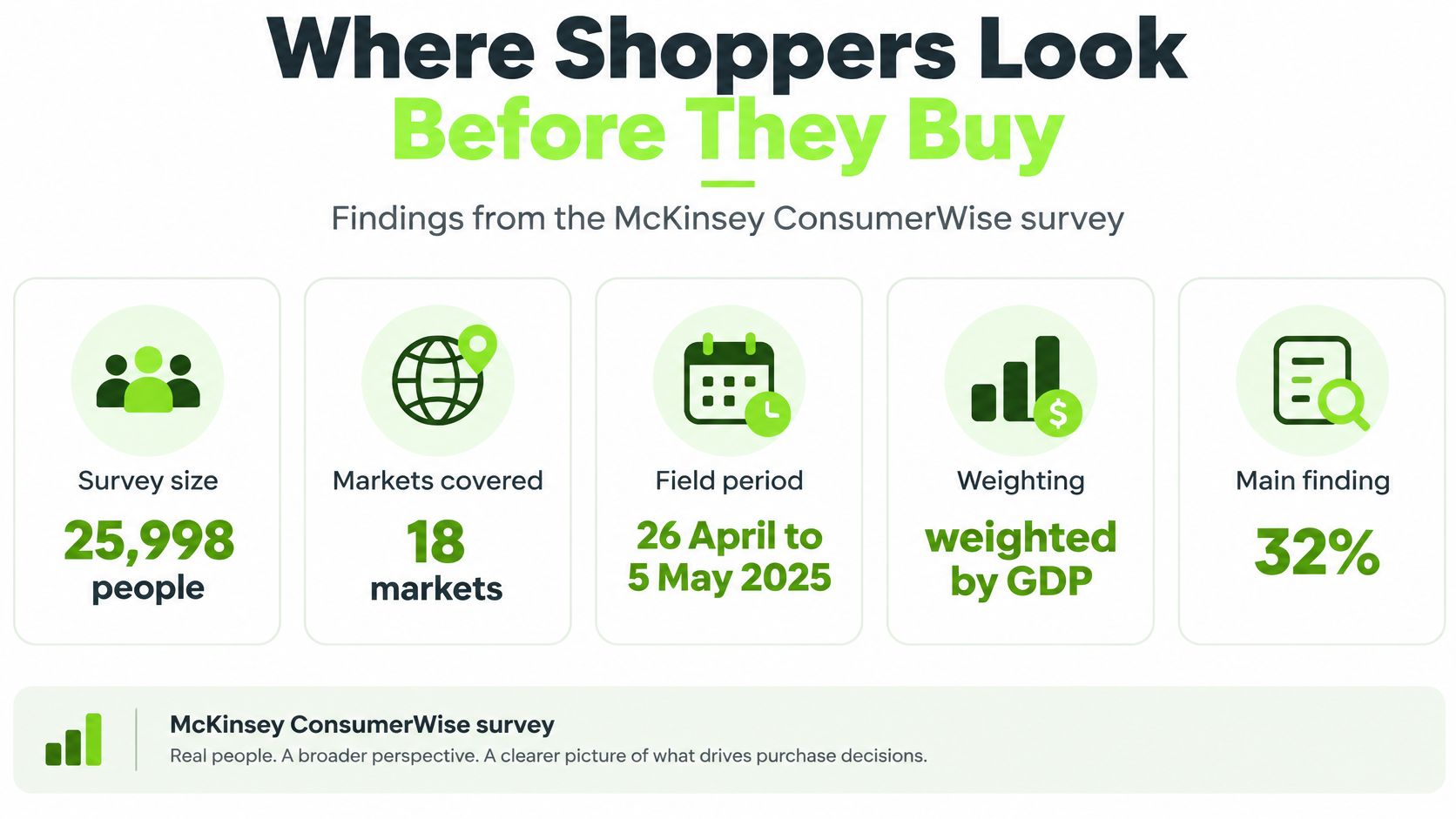
32% of consumers used social media for product research, up from 27% in 2023, according to McKinsey's 2025 ConsumerWise survey; roughly half of surveyed consumers in India researched products on social media before purchasing. The survey covered 25,998 consumers across 18 markets, was fielded from April 26 to May 5, 2025, and weighted results according to each country's contribution to global GDP.
Those findings describe a channel people use to investigate products, not merely somewhere they encounter advertising. A shopper might discover a purifier in a creator demonstration, check filter complaints elsewhere, and only then visit the retailer.
Keep the survey's scope visible when interpreting the headline.
Record a path rather than a channel total
A country label changes the meaning of an observation. A campaign visible in India doesn't establish availability, delivery economics, or shopper expectations in your home market.
For an initial pass, select your home market, a market where social discovery matters to your category, and a destination the competitor already serves. This is a manageable sampling choice, not a claim that those markets represent everyone.
Use a short observation log:
- Date and country: Record when and where you checked, including the delivery destination selected on the store.
- Channel and shopper task: Note whether the page helps someone discover, compare, verify, or purchase.
- Recurring or isolated: Separate a repeated customer question from a temporary campaign message.
- Next destination: Record where the shopper must go to resolve missing information, such as a marketplace review or returns page.
Don't assume that a mobile purchase began on mobile. Someone can compare specifications on a laptop, discuss the choice offline, and pay from a phone. Device-level conversion reporting describes part of that path, not the whole decision.
Keep product-level evidence separate
A store can attract attention for a different product from the one you're assessing. Use a store bestseller investigation to identify candidates, then verify the specific offer and its customer evidence.
Likewise, a search result for the brand doesn't tell you whether shoppers want this variant. Record model names, compatible accessories, and the questions people ask before assuming broad brand interest supports your proposed SKU.
Refresh the path when a competitor changes its offer or enters another market. Keep historical observations instead of overwriting them, so a temporary launch campaign doesn't become your permanent description of how shoppers discover the product.
Ask a counterfactual question: Which channel would still show this product if paid social were paused for a month? If you can't name one, you have a channel-dependence question to test, not a reason to invent organic demand.
Checks That Stop a Bad Product Call
A persuasive summary can conceal an incomplete investigation. An AI assistant might compare features accurately while omitting return costs, delivery restrictions, or a recurring complaint that changes the buying decision.
A 2025 consumer shopping survey reported that 49% of respondents used AI tools for shopping research; the accompanying evidence also reports 31% of U.S. consumers preferring AI for product search, compared with 21% preferring legacy search engines. Usage is a reason to audit recommendations carefully, not evidence that recommendations are dependable.
Verify the summary before using it
Keep the AI output as a draft interpretation. Attach evidence to each material claim before it enters your decision file.
- Check freshness: Open the cited page and inspect whether the price, model, availability, and terms remain current.
- Repeat the question independently: Use another assistant with the same buyer, country, and constraints. Investigate disagreements rather than selecting the answer you prefer.
- Mark commercial exposure: Label sponsored placements and affiliate content wherever identifiable. Don't classify them as independent recommendations without clear evidence.
- Verify both sides: Match specifications against first-party pages and ownership claims against independent reviews.
- Search for omissions: Ask specifically about return shipping, consumables, delivery exclusions, negative reviews, and unavailable variants.
For the purifier example, a feature comparison is incomplete if it ignores replacement-filter availability. A recommendation can be technically plausible and still unsuitable for the intended market.
Evidence check: If you can't trace a decision-changing claim to an accessible page, keep it out of the verdict.
Validate the offer through checkout
Demand and checkout usability are different questions. A shopper who understands and wants the product may still stop after seeing unexpected shipping charges or struggling with a form.
Baymard's checkout-usability research benchmarks 344 leading U.S. and European ecommerce sites and reports the checkout findings below. Treat them as reasons to inspect your purchase path, not as promised improvements for your store.
Checkout and AI-check benchmarks
| Signal | Value | Action |
|---|---|---|
| Checkout rated mediocre or worse across the benchmarked sites | 65% | Fix checkout before judging demand |
| Checkout rated good across the same sites | 2% | Don't assume a familiar checkout is usable |
| Average checkout form elements versus an observed ideal | 23.48 versus as low as 12 | Count elements during the task test |
| U.S. online shoppers who abandoned a long or complicated checkout | 17% | Log complexity as an abandonment reason |
| Respondents using AI tools for shopping research in 2025 | 49% | Verify each recommendation |
| U.S. consumers preferring AI versus legacy search | 31% versus 21% | Check source freshness before trusting the comparison |
Estimate delivered cost, fulfillment constraints, and returns exposure before testing. Build a minimum viable product page, observe task completion, and only then run a controlled experiment.
Choose completed purchase rate as the primary experimental metric, with margin and returns exposure as guardrails. Hold price, traffic source, promotion, and device mix steady while testing a material change; report uncertainty and inspect country and device segments.
If purchases remain weak after comprehension and checkout problems are addressed, investigate differentiation and product saturation. Don't call a crowded category saturated because your first test failed.
The metric worth trusting is completed purchasing under a defined offer and test setup, not an increase in button clicks or an isolated desktop improvement.
Save a Dated Verdict on One Store
Close the file with a decision, not a longer shortlist. Write go, watch, or drop, date it today, and name the fact that would change your mind.
For example: Watch. Shoppers understand the offer, but replacement-filter availability remains unverified. Change to go when the supplier confirms replenishment terms that support the intended market.
Attach the decision to a live record
Keep the verdict beside the store's current products, prices, live Meta ads and recorded start dates, apps and pixels, measured traffic trend, and comparable stores. At AdLibrarySpy, our free store dossier brings together SimilarWeb-measured traffic and trend, products and prices, installed apps and pixels, live Meta ads, and similar stores in the same niche.
Keep every saved creative labeled as a hypothesis. A monitoring record should help you notice changes, not turn yesterday's assumption into today's fact.
Set a monthly recheck with a short trigger list:
- Offer changes: New prices, bundles, variants, or delivery terms.
- Promotion changes: New creatives or a stronger dependence on coupons.
- Evidence changes: A traffic swing, contradictory claim, or emerging review theme.
Save what changed and whether it affects the verdict. If another product looks viable, give it the same audit rather than adding it to an untested list. Stop when you have a defensible next action.
AdLibrarySpy offers free shop search, a Meta ads library searchable by brand, niche, format, placement, and country, plus competitor tracking and shared workspaces. Visit AdLibrarySpy to build a live record for one store, attach your dated verdict, and monitor the evidence that could change it.
More guides
Try AdLibrarySpy free
Search millions of stores and real Meta ads. No card, no trial — sign up with just your email.