what is competitor intelligence
What Is Competitor Intelligence? a Guide for Ecommerce
What Is Competitor Intelligence? Learn how ecommerce teams turn store, ad and traffic signals into smarter pricing and product decisions.
Updated October 28, 2026

Competitor intelligence is a structured process for gathering, validating, analyzing and distributing public information about rivals, markets and customers so a business can make a specific decision about pricing, products, positioning or its next move.
You've noticed a rival promoting a bundle that looks much like yours. Its ads keep appearing, its landing page has changed, and someone on your team asks whether you should copy the offer. The useful response isn't to collect more screenshots. It's to work out what you need to know before risking your own budget.
Table of Contents
- What Competitor Intelligence Means for an Online Store
- How Competitor Intelligence Turns Signals Into Decisions
- Where Ecommerce Teams Find Competitor Data
- Everyday Uses of Competitor Intelligence in Ecommerce
- Why Competitor Signals Mislead Without Context
- Keeping Competitor Research Legal and Trustworthy
- Start With One Competitor Question This Week
What Competitor Intelligence Means for an Online Store
Competitor intelligence isn't a list of competitors or a folder of screenshots. It's an organized way to connect outside observations to choices inside your business.
The discipline has deep strategic roots. The Decision Lab's guide to competitive intelligence identifies Michael Porter's 1980 publication of Competitive Strategy as a foundational milestone and describes the field's growing prominence as a distinct management discipline during the 1980s. Porter's contribution was to connect organized competitor analysis with strategy, rather than treating it as occasional observation.
For an online store, that means looking beyond the rival selling a similar product. Customers, suppliers, substitutes and new entrants can also change your options. A customer might choose a subscription instead of another standalone purchase, for example.

Monitoring isn't the same as intelligence
People asking what is competitor intelligence often mean several different activities:
- Competitor monitoring means noticing a change, such as a rival reducing its listed price.
- Ad spying usually means inspecting rival advertisements, sometimes with the intention of copying them.
- Competitor intelligence means interpreting the change and deciding whether it should affect your next move.
Monitoring is a thermometer reading. Intelligence is the forecast that helps you decide whether to bring an umbrella. You need observations, but observations alone don't tell you what to do.
Say a rival's free-shipping banner appears on Monday. The useful question is whether it supports a higher basket value, clears stock, or tests a temporary promotion. Each explanation would justify a different response.
Your research scope should follow how customers discover and compare options. If AI-assisted discovery matters to your category, Silver Spoon Agency's resource on understanding competitors' visibility in AI answers offers another area to investigate alongside search results and advertising.
First action: Write down the business decision your research must inform before collecting anything.
Make it specific: whether to test a shipping threshold is a better starting point than wanting to know everything about a rival.
How Competitor Intelligence Turns Signals Into Decisions
The output should be a recommendation someone can use, not a dataset someone else must decipher. A spreadsheet can hold the evidence, but it doesn't replace the judgment.
The Encyclopedia.com entry on competitive intelligence distinguishes raw data from contextual information and decision-supporting intelligence, and describes a workflow that includes planning, collection, analysis, communication and feedback. That distinction gives a small ecommerce team a workable procedure.
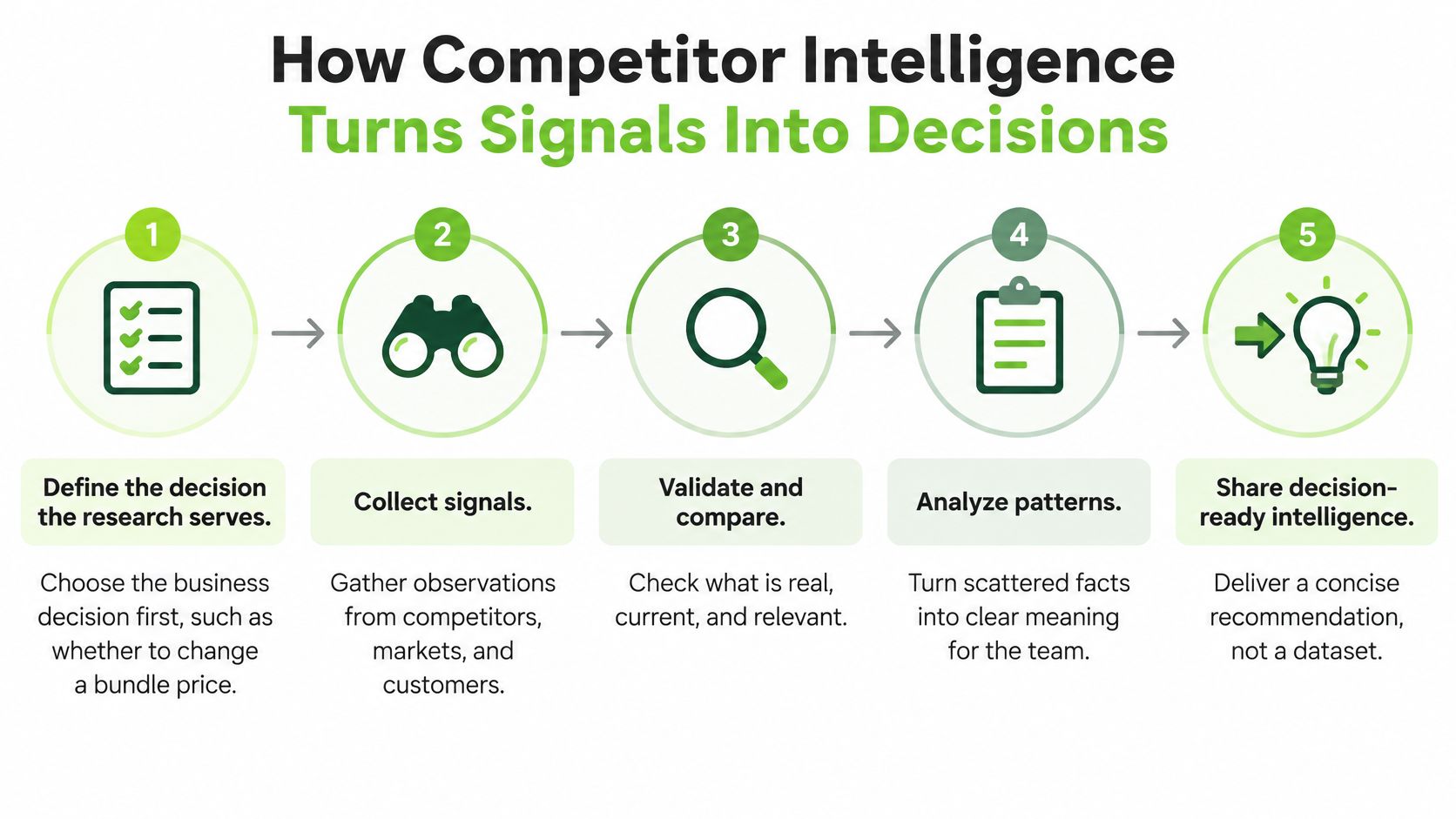
Build a repeatable decision cycle
- Define the decision. Ask whether to change a bundle price, not what competitors charge. A bounded question prevents unrelated observations from taking over.
- Plan the evidence. Identify what would support or weaken the proposed change, including comparable products, shipping costs and your own margin requirements.
- Collect public signals lawfully. Gather relevant ads, product pages and offer details without seeking confidential access.
- Process the observations. Normalize product sizes, preserve original wording and timestamp captures so comparisons remain meaningful.
- Analyze alternative explanations. A cheaper bundle could reflect smaller contents, clearance stock or a different customer segment.
- Communicate a recommendation. State the proposed action, evidence, uncertainty and confidence level in language the decision-maker understands.
- Act and record the outcome. Assign an owner and a review point so the team learns whether its interpretation helped.
The collection-to-recommendation path is easier to follow when each stage has a clear purpose.
From raw observation to decision
The examples below are hypothetical. They show how the same advertising observation becomes more useful as you add context and interpretation.
| Level | What it is | Ecommerce example | Decision it supports |
|---|---|---|---|
| Data | Raw observation with no context | A rival's Meta ad seen on 3 March | Nothing yet; log it with date and source |
| Information | Observation organized with source, date and channel | The ad was observed across 14 days and links to a new landing page | Whether the page changed alongside the ad |
| Intelligence | Assessment that explains implications and confidence | The same bundle appears in five creatives over six weeks, suggesting a tested offer | Whether to run a smaller bundle test this quarter |
Keep source, observation date, reporting period, geography, channel, confidence and interpretation in separate fields. Otherwise, a teammate may mistake your interpretation for something directly observed.
Use a dated timeline to align creative changes with launches, landing-page revisions and traffic movements. Compare the period before and after each event, while keeping possible seasonal or promotional explanations visible.
End with a testable hypothesis: the refreshed creative may make the bundle's value clearer, so test clearer value messaging against your current version. That gives your team something it can evaluate rather than a story it can only debate.
Where Ecommerce Teams Find Competitor Data
The question picks the source. Product pages help you compare assortment; ad records help you inspect messages; customer reviews help you identify frustrations. None answers every question about a store.
Before collecting, define your comparison set. Include direct rivals serving a similar customer with a similar product, plus substitutes competing for the same budget. Record why each store belongs so an unusually large or differently positioned business doesn't become an accidental benchmark.
Common competitor data sources and their limits
| Source | What it reveals | Typical limit |
|---|---|---|
| Meta Ad Library | Available Facebook and Instagram ads, copy, destinations and displayed run dates | Meta only; historical availability varies by ad category and region; ordinary commercial records don't establish spend or conversions |
| Store traffic estimates (SimilarWeb) | Monthly visits and trends for the exact store domain | Modelled estimates; small or new stores may have limited coverage |
| Public Shopify product feeds | Product names, listed prices and catalogue changes | List prices don't reveal margins or every checkout discount |
| Storefront apps and tracking pixels | Detectable tools, such as reviews, upsells or advertising pixels | Installation doesn't establish effective use |
| Landing pages and site copy | Offers, guarantees, shipping promises and positioning | A snapshot of what was visible when captured |
| Public reviews and marketplace listings | Customer language, complaints and ratings | Reviewers are self-selected; manipulation can distort ratings |
| Social posts and newsletters | Launch announcements, promotions and founder messaging | Selective, promotional accounts of the business |
| Store directories and market indexes | Peer stores grouped by country, category or growth indicators | Coverage and classifications differ across indexes |
Match sources before combining them
Your own analytics and order records provide the first-party baseline. Compare external observations with what you know about your customers, acquisition costs, returns and contribution margin, rather than assuming another store's visible activity sets the standard.
For customer-language questions, SellerAI's guide to review analysis for e-commerce sellers is a useful companion. Group complaints by purchase problem, such as unclear sizing or difficult packaging, rather than treating the average rating as the whole answer.
Our sourcing separates store records from the PlatformDTC market index, traffic from SimilarWeb for the exact store host, ads from the Meta Ad Library and products from each store's public Shopify feed. Those origins matter because the records describe different parts of the business.
For a concrete research starting point, use the Fashion Nova store record to frame a comparison question, not to assume the brand is a suitable peer for every fashion retailer.
Pair independent evidence before drawing a conclusion. An ad and its landing page can confirm consistent messaging, while reviews can help assess whether that message addresses a customer problem. Record reporting periods carefully: older traffic estimates and a currently visible advertisement don't describe an identical window.
Everyday Uses of Competitor Intelligence in Ecommerce
A skincare store notices a rival repeatedly advertising a travel-size bundle. In this hypothetical example, the team observes five creatives over six weeks, while its own travel products have no paid presence.
The team doesn't immediately copy the bundle. It checks whether the rival changed its landing page, compares price per millilitre and asks whether its own customers want portable products or a cheaper way to try the range.
Each check answers a different question. The creatives show sustained emphasis. The landing page shows whether the offer itself shifted. The price comparison shows where the rival sits on value. Only the customer question, though, tells the team whether the idea fits its own buyers.
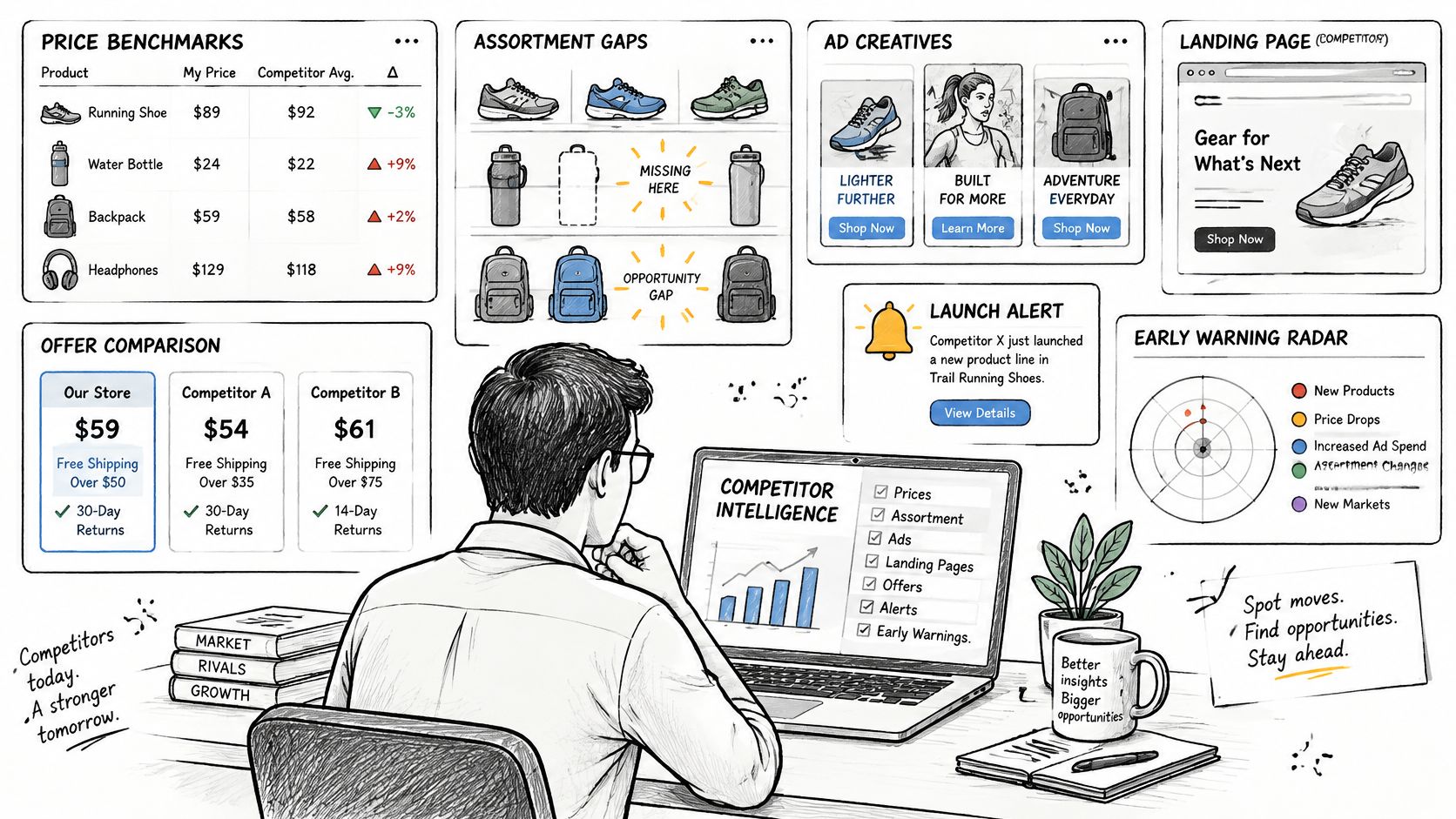
The store then tests a limited travel set with a clear success criterion based on its own economics. The useful result isn't learning how closely it can resemble the rival. It's learning whether its customers value the offer enough to buy it at a sustainable margin.
Common uses of competitor intelligence in ecommerce
These are practical applications, with hypothetical examples where quantities appear.
| Use | Question it answers | Example | Decision it supports |
|---|---|---|---|
| Pricing benchmark | How do rivals price the same product type? | Compare price per millilitre with a rival's set | Whether to change a bundle price |
| Assortment gap | Which products do rivals list that we don't? | A rival's travel-size set is absent from our catalogue | Whether to test a new SKU |
| Ad creative research | Which messages repeat over time? | One bundle appears in five creatives over six weeks | Whether to run a smaller bundle test |
| Landing page benchmark | Did a rival's page change with its ads? | A campaign links to a newly revised offer page | Whether to revise our offer page |
| Market entry screen | Does the category show sustained activity? | Five niche stores screened for traffic and advertising activity | Whether to investigate a category launch |
| Early warning | Is a rival launching or shifting emphasis? | A free-shipping banner appears on Monday | Whether to hold prices or investigate a response |
Notice the pattern across the table. Every row ends in a decision the observing store can defend on its own numbers, not a copy of the rival's move. That is what separates intelligence from surveillance.
Before changing prices, separate the competitor's advertised offer from your own margin floor. The pricing strategy insights from Next Point Digital provide a focused resource for approaching competitor price monitoring.
A market-entry analyst applies the same discipline at a different scale. Sustained activity across comparable stores may justify customer interviews and a demand test, but it doesn't establish that another entrant will succeed. A Gymshark store record can serve as an exercise in examining positioning without assuming a prominent brand's approach will transfer to a smaller shop.
Different roles draw different things from the same observations. Founders use them to allocate resources. Paid social marketers turn them into creative hypotheses. Agencies organize them into client recommendations, while analysts keep the records comparable over time.
The competitive-intelligence thesis hosted by Jönköping University describes intelligence as a means of sensing opportunities and threats and supporting organizational learning. In practice, the timing matters: a repeated pattern deserves closer investigation than an isolated appearance.
Why Competitor Signals Mislead Without Context
A competitor signal is evidence, not proof of commercial success. Seeing an activity establishes something about what was visible, not necessarily why the rival chose it or what happened afterward.
The Cogent Business & Management article on competitive intelligence discusses ambiguity and overlap in how the discipline is defined. For a store operator, the practical distinction is whether the work ends with collected observations or continues through analysis to an actionable recommendation.
What each competitor signal can and cannot prove
| Signal | What it suggests | What it cannot prove | Test to run |
|---|---|---|---|
| Live Meta ad | The rival is trying a message or offer | Spend, return on ad spend or effectiveness | Test the underlying message with original creative |
| Traffic rise on a store | Campaign activity or growing interest | Revenue, conversion or margin | Test the suspected acquisition angle and assess your own qualified visits and orders |
| New product listed | Assortment expansion into a category | Demand or profitability | Offer a small batch or clearly described pre-order |
| Same creative repeated over weeks | Sustained emphasis on an offer | That the offer is profitable | Price-test a comparable offer within your margin limits |
| No ads found in Meta Ad Library | No matching Meta ads were found in the search | No activity on Google, TikTok or email | Inspect other public channels and the store's pages |
The cheapest useful test addresses the uncertainty. Watching your own analytics without changing anything won't explain a rival's traffic increase. Testing a relevant acquisition message can tell you whether that angle attracts buyers to your store, which is the decision you can control.
Mistakes that lead teams to copy too quickly
- Active ads don't mean profitable ads. The advertiser may be experimenting, accepting acquisition losses or failing to stop an ineffective campaign.
- Traffic growth doesn't mean sales growth. Visitors may arrive through publicity, low-intent content or promotions that don't produce worthwhile orders.
- Missing records don't mean inactivity. A Meta-only view can't describe campaigns on Google or TikTok, and a search can miss relevant records.
Practice separating these claims when inspecting the QVC store record. Write down what the visible record establishes, then list the additional assumptions you'd need before recommending a change.
More competitor data can make decisions worse when it encourages imitation without customer validation. A team can spend so long cataloguing rival offers that it stops asking whether its own buyers want them.
Name the uncertainty and the independent test that could change your conclusion.
Confidence should describe a specific claim. You might have high confidence that a rival changed its shipping message, but low confidence about the business reason. Keeping those judgments separate prevents a clear observation from lending false certainty to a speculative explanation.
Keeping Competitor Research Legal and Trustworthy
Public business information and personal data require different treatment. Product listings, published prices and publicly accessible advertisements are appropriate starting points; customer identities, private messages and confidential records aren't material you should gather just because they might be useful.
Public visibility also isn't blanket permission to collect, republish or process everything. Platform terms, privacy obligations and intellectual-property restrictions can still apply, and the appropriate approach depends on the material and jurisdiction.
Set boundaries before collecting
- Use open sources. Stay with publicly accessible business pages and authorized research tools.
- Respect access restrictions. Don't bypass logins, paywalls, technical controls or other restricted areas.
- Follow platform terms. Observe permitted uses, collection restrictions and fair-use limits.
- Preserve provenance. Record the original source and collection date, and retain only what supports the business question.
- Exclude deception and confidential material. Don't impersonate customers or employees to obtain information, or solicit stolen documents.
- Minimize personal data. Summarize recurring customer concerns without copying names or other unnecessary identifying details into shared records.
Consumer expectations reinforce the need for care. Adobe's 2025 retail digital trends report reports that 87% of consumers expect retailers to handle personal data responsibly and securely, while 74% want clear disclosure when AI-generated content, recommendations or images are used.
Review AI analysis before anyone acts
AI can help group messages, summarize changes and draft hypotheses. It can also turn a traffic estimate into a statement about sales, merge records from different periods or describe an inferred intention as a fact.
Require each material claim in an AI-assisted brief to point back to an identifiable source. A person should check whether that source supports the exact claim, including the store, channel, geography and reporting period.
Publication check: Could a colleague reproduce this conclusion from the sources attached to it?
Keep generated interpretation separate from captured observations. If the source doesn't support a claim, remove it or label it as a hypothesis rather than making the wording sound more cautious.
Agencies and shared research teams need particular discipline because colleagues can reuse an unverified summary across client recommendations. Assign a reviewer before circulation and preserve corrections where everyone using the brief can see them. Trustworthy intelligence depends partly on what your team refuses to claim.
Start With One Competitor Question This Week
Choose a question small enough to investigate in an afternoon. Whether to test a starter bundle is manageable; discovering a competitor's entire strategy isn't.
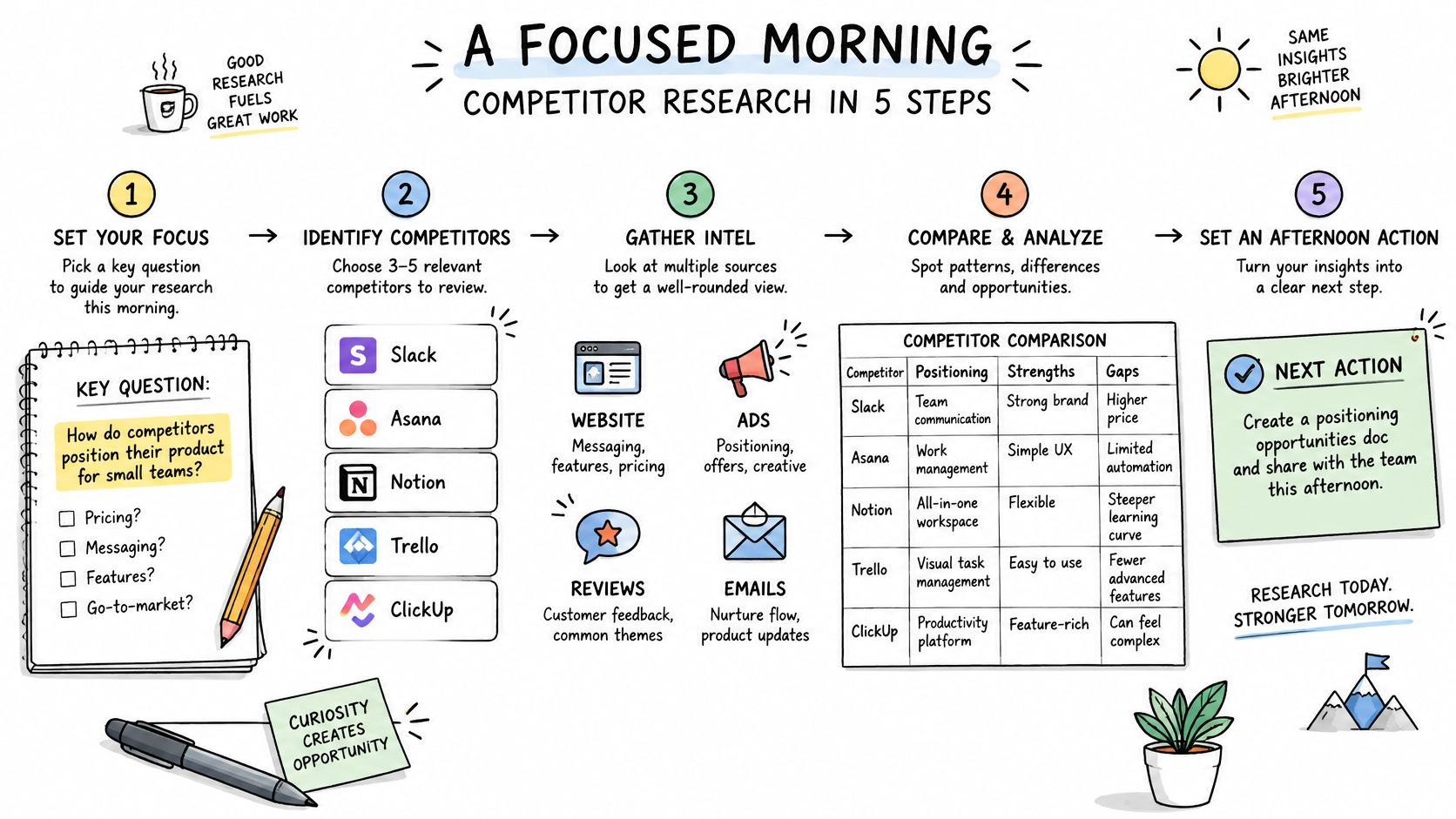
Run a focused first cycle
- Write the decision. Specify the choice and who will make it.
- Choose comparable stores. Select a manageable peer group based on customer, product and positioning.
- Gather independent signals. Pair relevant advertising observations with product, customer or traffic context.
- Log the evidence. Preserve the source, date, reporting period and confidence, keeping interpretation separate.
- Set a test and review date. Choose the least costly experiment that could meaningfully change your decision.
Use this sequence to keep the work focused on action.
Our free store dossiers bring SimilarWeb-measured traffic and trends, products and prices, apps and pixels, live Meta ads and similar stores into one view. Brandtracker records traffic and advertising snapshots and emails you when tracked activity changes, helping a shared team maintain its evidence.
The tool shortens collection. The decision, the interpretation and the test stay with your team.
AdLibrarySpy offers store research, Meta ad exploration and competitor tracking so you can organize the signals behind a specific business question. Visit AdLibrarySpy to choose comparable stores, examine their public activity and build an evidence-backed test for your own shop.
More guides
Try AdLibrarySpy free
Search millions of stores and real Meta ads. No card, no trial — sign up with just your email.