competitor analysis tools
10 Competitor Analysis Tools for Ecommerce in 2026
Compare 10 competitor analysis tools by data coverage, research features, collaboration, and use cases for ecommerce teams.
Updated November 13, 2026
You spend Monday checking a rival's Facebook ads. Tuesday goes on traffic estimates. By Friday you've noticed their hero product price moved, and you still can't say whether the new campaign had anything to do with a sales lift. Three tabs closed themselves days ago and your notes don't line up.
That's the core failure mode in ecommerce competitor research. The data exists, but it sits in separate products built on separate definitions. A traffic panel counts visits one way, an ad library shows creative without spend, a keyword tool shows demand without the store behind it. Stack ten of them and the process costs more attention than the decisions it supports.
This guide sorts ten competitor analysis tools by what they can actually see: ad platform coverage, store and traffic data, search data, and team collaboration. Each entry ends with the workflow it fits and the question it can't answer, so you can start from your research question instead of a feature list.
If you want a structured way to break a rival's business into parts worth investigating, Headline Marketing Agency's competitor framework is a practical starting point. Then pick the tool that fills the gap you found.
Table of Contents
- 1. AdLibrarySpy
- 2. Meta Ad Library
- 3. Similarweb
- 4. Semrush
- 5. Ahrefs
- 6. SpyFu
- 7. Minea
- 8. WinningHunter
- 9. Foreplay
- What it sees
- Why saving beats scrolling
- 10. BigSpy
- How the 10 competitor analysis tools differ by data coverage, store-level research, and team features
- Match the Tool to the Question You Are Actually Asking
1. AdLibrarySpy
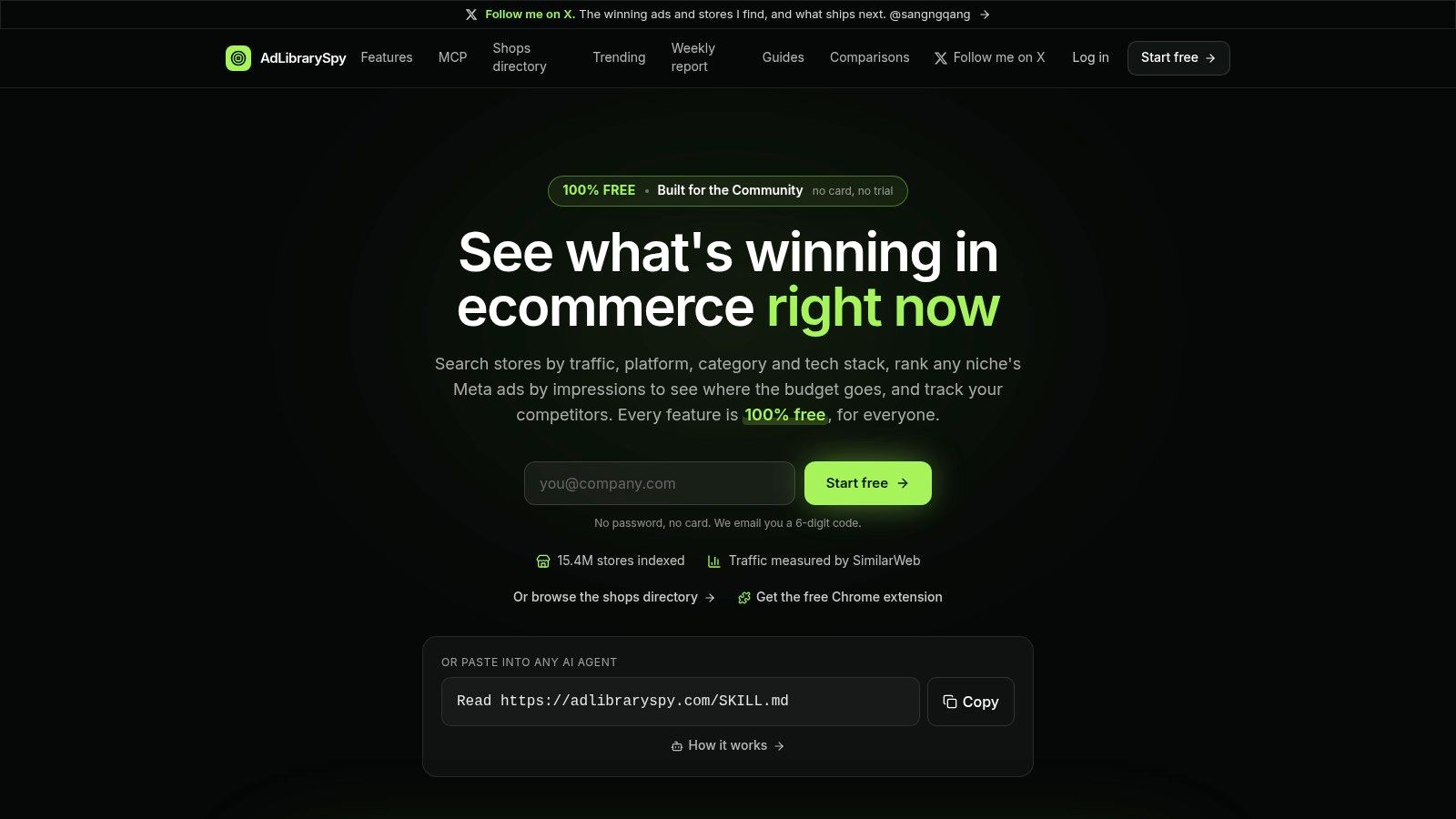
The shops directory indexes 14.7 million stores, and the filters do the work a spreadsheet used to: platform, category, traffic, growth, country, installed apps and tracking pixels, combinable in a single pass.
What a store dossier actually holds
Open one shop and the dossier keeps traffic history for that exact host, visitor countries, products and prices, the apps and pixels it runs, and its live Meta ads in one view. The ad library underneath searches Facebook and Instagram creatives by brand, niche, format, placement and country, and each record carries the copy, landing page, run dates and other ads from the same brand.
Continuity is the underrated part. Brandtracker snapshots a competitor's traffic and ad activity and emails you when either changes, so a new creative angle or a catalogue shift surfaces without re-running Monday's search. Team workspaces, weekly reports and an MCP connection for compatible AI assistants sit inside the same account, and signup uses an emailed six-digit code with no password and no card.
Where the coverage ends
Meta only. TikTok and Google ads aren't in the index, and there's no ad spend, impression count or modelled revenue. Figures show their source and reporting period, and missing values are omitted rather than estimated, which is the honest version of a limit.
Consolidation is the argument for this shape of tool. In a Forrester survey of 150 marketing, analytics and IT executives commissioned by Google, only 26% said their marketing-analytics tools were well integrated and worked well together, while marketers running a stack of at least five tools were 39% more likely to report improved program performance (Google Analytics blog).
Use it when: your question starts with a store rather than a keyword. Finding who is scaling, what they run, and what changed since last week becomes one workflow instead of four.
2. Meta Ad Library
A launch decision often starts with a narrow question: is a competitor running this offer on Meta, and what does the ad send shoppers to? The Meta Ad Library is free and lets you search by advertiser or keyword, then filter by country, platform and media type. Ad records show the creative, copy and destination link (Meta Ad Library).
The library shows individual ads, not the store's wider performance. It has no traffic history or product catalogue, and it does not report spend or impressions. A live ad confirms that a campaign is running; it does not show whether the campaign is profitable.
Read the run dates alongside the creative. An ad that has been running for months is a reason to investigate its offer and landing page, not proof that the approach will work for another brand.
For a practical way to compare creative, landing pages and run dates, see this guide to reading Instagram dropshipping ads. If that research will inform a creator brief, the Best UGC Video Generator rankings compare tools for turning ideas into testable assets.
Fit: checking a named brand's live Meta activity before a pitch or product decision. Limit: the library shows what a brand is running, not what those ads are achieving.
3. Similarweb
Traffic benchmarking is the core job here, and it happens at market level rather than store level. You can compare sites, break down acquisition channels, inspect top pages and site structure, and research a category before you know which domains matter (Similarweb).
The estimate problem is real, and worth understanding before you buy. Figures come from panels and modelling, not from a competitor's analytics, and accuracy is stronger on high-traffic domains than on small shops. Treat a large month on a mid-size store as a direction, not a reading.
Adoption sets the expectation. Gartner Digital Markets found that 81% of surveyed business leaders used BI and analytics software, with 46% adopting it within the previous two years, across 2,028 respondents (Gartner Digital Markets). Buyers who already run dashboards don't need more charts. They need records that name their source and reporting period, and that omit gaps instead of filling them with a model.
- Best for: sizing a market or comparing traffic across a handful of rivals.
- Weak for: ad creative research, since there's no searchable Meta library.
- Watch: plan cost against how many domains you check each month.
If discovery is the only step you need, this walkthrough on finding similar sites to a competitor covers the workflow without a subscription.
4. Semrush
What it sees
Semrush covers the search side broadly: domain and keyword research, keyword-gap comparisons, position tracking, backlink profiles and site audits, with historical data on higher tiers (Semrush). For an ecommerce team, the useful output is usually a gap list. Rivals rank for a category term you don't target, so that becomes a content or landing-page task with an owner and a deadline.
Breadth is both the pitch and the problem. A suite this wide takes weeks to learn well, and the search data still doesn't show sales, margin or what a competitor's social ads are doing. It tells you where demand is contested, not who is winning the transaction.
Where it stops
Search visibility is an input to revenue, never a proxy for it. A competitor with weaker rankings can still outsell you on paid social, retention email or a better product page.
- Fit: SEO and paid-search planning where keyword gaps and competitor domains belong in one system.
- Limit: cost climbs with limits, and the feature set rewards a named owner rather than occasional use.
If you're still separating competitor research from market research, this explainer on what competitor intelligence actually covers draws the line between the two.
5. Ahrefs
Ahrefs is where most SEO teams start, mainly because of backlink depth. Site Explorer gives you any domain's organic pages, keyword positions and referring domains, while the content gap views show queries rivals rank for that you don't (Ahrefs).
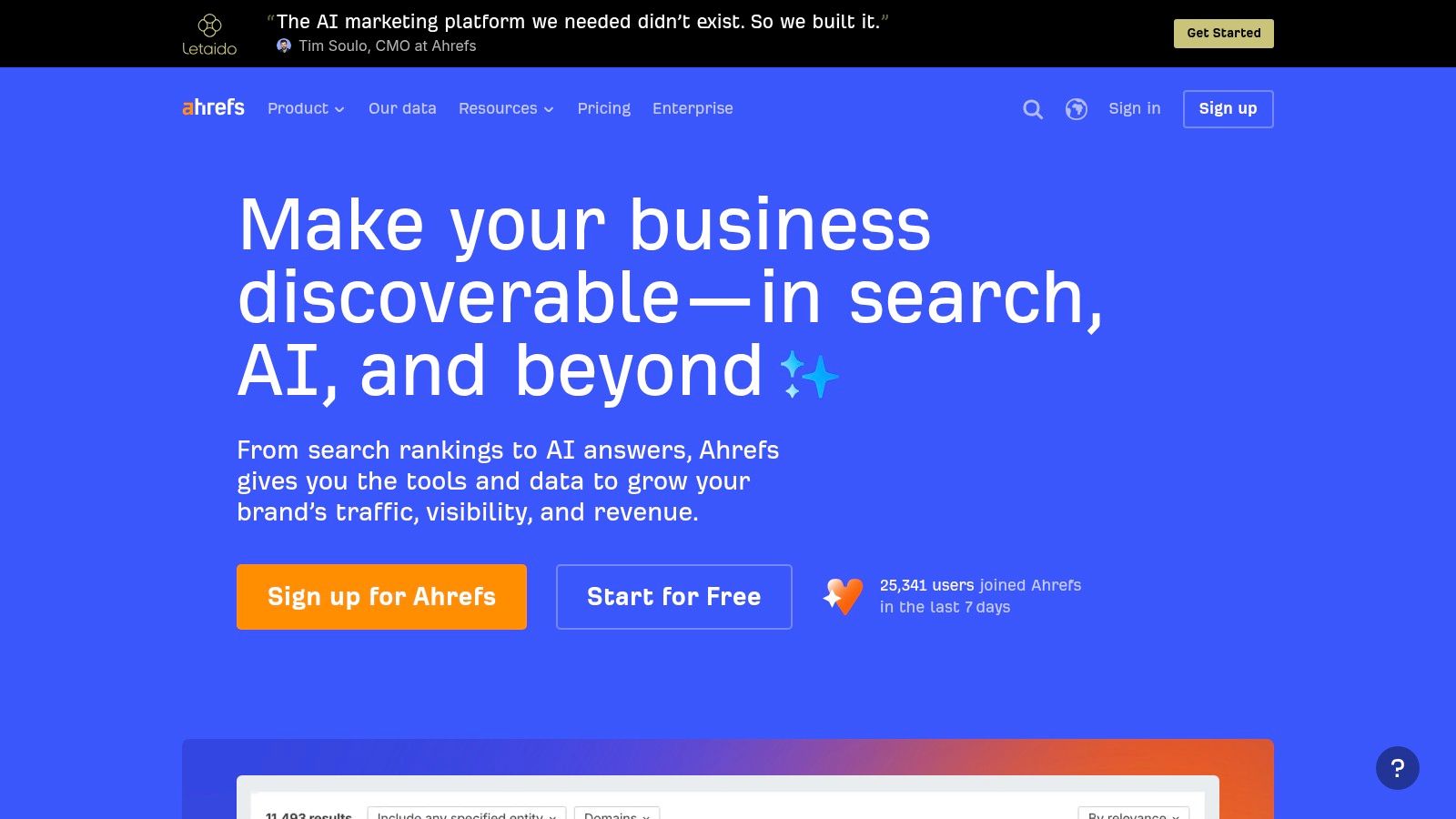
The practical difference from a broad suite shows up in link work. If a competitor outranks you on a category term, Ahrefs usually tells you whether the cause is content coverage or a link profile you can't match.
What it won't do is describe the business. There are no store profiles, no traffic panel for a Shopify shop, and no Meta ad archive. Usage limits also bite when you're checking twenty competitors instead of three: a lower tier runs out of rows faster than people expect.
- Strong: organic and backlink research on specific domains.
- Weaker: anything involving store operations, product catalogues or social creative.
- Watch: plan entitlements, not just the headline price.
For a paid-social question this is the wrong purchase, and buying it because it appears on every list wastes a budget cycle. Match it to a search question or leave it out.
6. SpyFu
SpyFu looks at one slice closely: what a domain does in search. You get its organic keywords, the Google Ads terms it has bought, ad copy variants, and a history that shows when a strategy shifted (SpyFu).
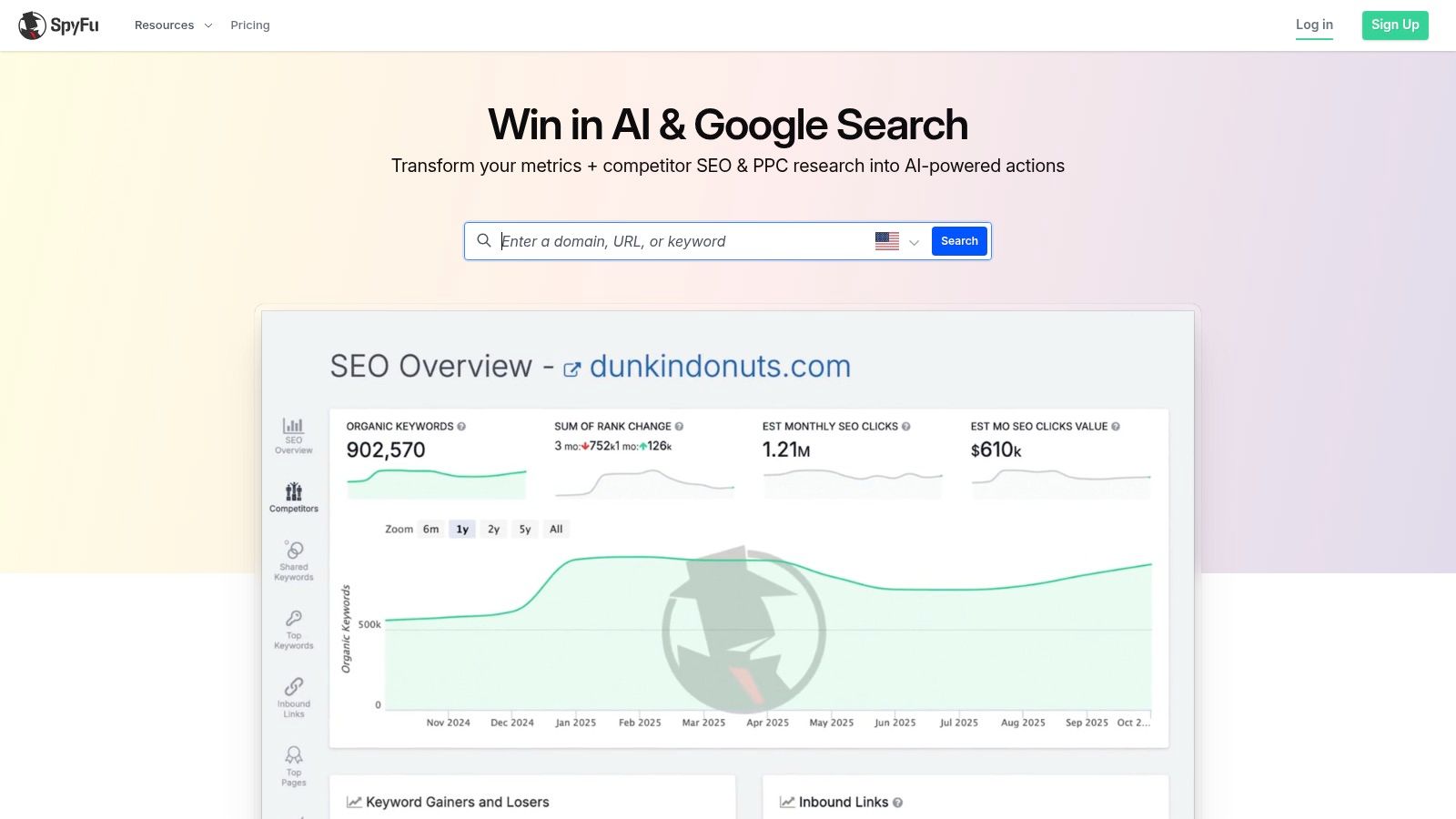
That history is the reason to use it. Seeing that a rival dropped a set of terms six months ago, or added landing pages ahead of a seasonal push, is more useful than a snapshot of today's positions.
The limitation is interpretive, and it applies to every ad-research tool. Visible activity doesn't prove causation. In a 2025 measurement study, 67.4% of respondents named proving incremental ROI their top priority, ahead of aligning metrics with business outcomes at 66.3% and improving cross-channel attribution accuracy at 55.1% (PPC Land).
A long-running ad tells you the advertiser hasn't turned it off. It doesn't tell you the ad is profitable.
Use SpyFu to build a hypothesis: this claim, this offer, this landing page, tested against your own traffic. Fit: paid-search and SEO research on domains you already know exist. Limit: search only, no social library, no store data, and deep history sits behind higher tiers.
7. Minea
A product can appear in ads aimed at several countries before it shows up in the stores you already track. Minea focuses on product and ad research, linking creatives to the products and shops behind them. Its coverage includes Meta and TikTok, with brand tracking for changes to watched competitors (Minea).
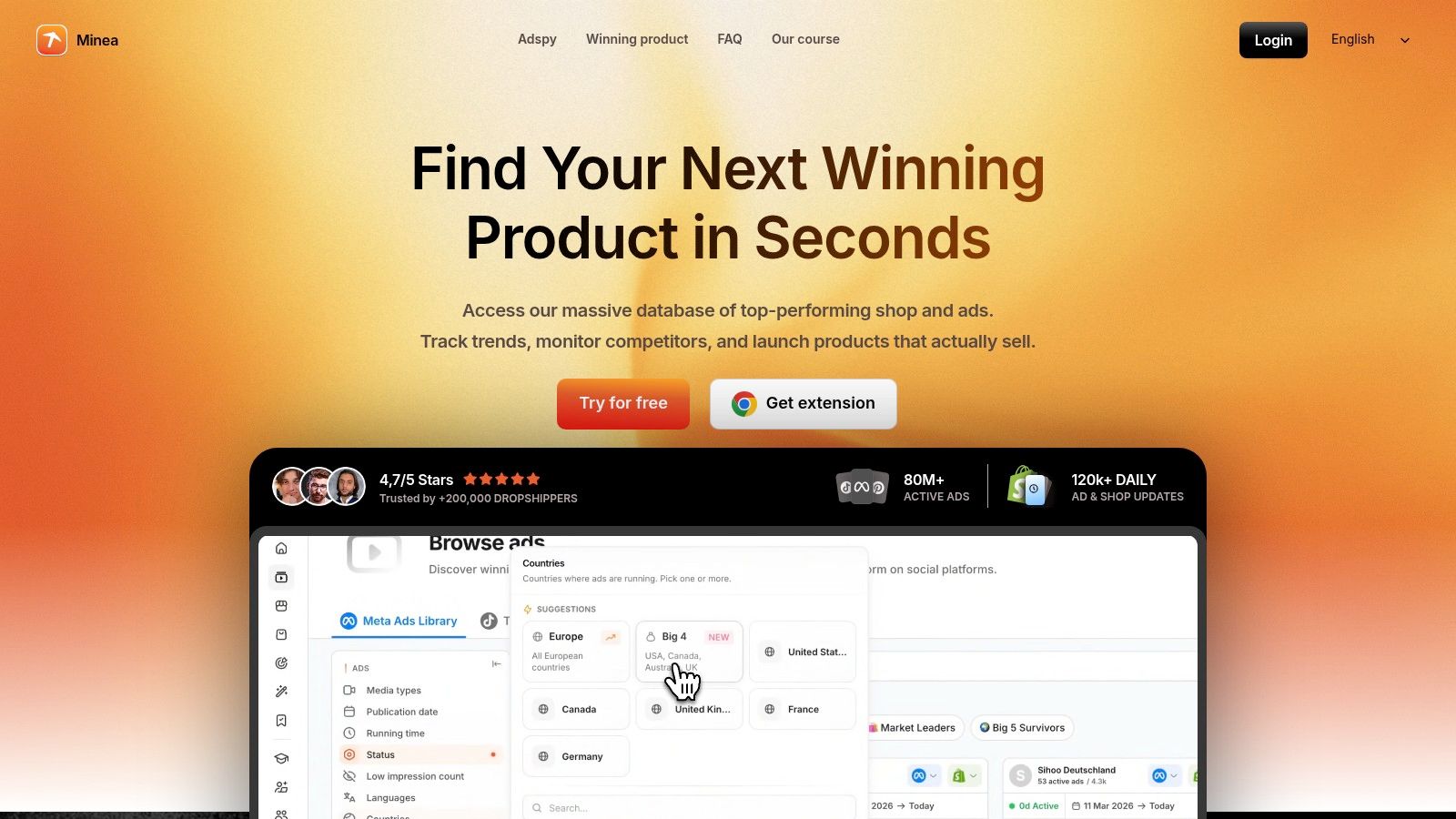
For product discovery, follow an item from its ad to the shops selling it, then compare the advertisers promoting it. Saved collections keep candidate products together for review.
Cross-border reach means a product may be sold in your market by sellers you do not track yet. Minea can help surface those advertisers, but the signals have limits:
- Plan allowances vary: monthly limits on searches and saved items affect how much research a team can do.
- Store figures are indicative: Minea is not a direct source of store traffic, so use its performance signals as estimates.
- Check network coverage: confirm that its Meta and TikTok data covers the markets you sell into.
Fit: product-first research into what is being advertised and which shops sell it. Limit: it does not independently verify store traffic, and plan tiers determine how much data you can access.
8. WinningHunter
WinningHunter combines a store database with ad research, a different starting point from the search suites above. Store explorer entries carry store, product and advertising information, and tracked brands surface marketing activity without repeated manual checks. On eligible plans the ad research extends to Meta, TikTok and Pinterest, with TikTok Shop product research included (WinningHunter).
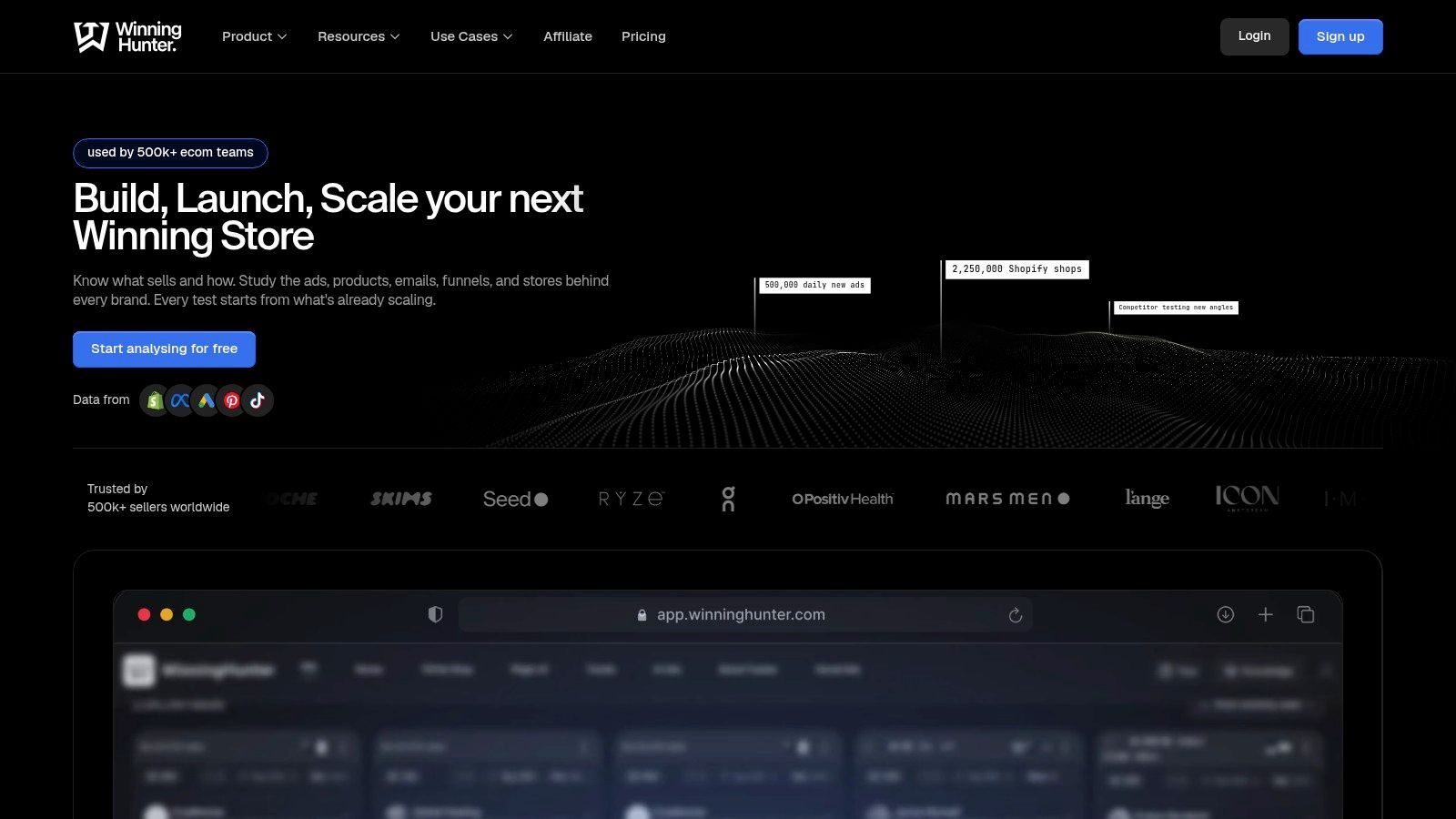
The mix is useful for discovery. Start from a niche, find stores with recent ad activity, then inspect the products and creatives behind them without leaving the tool.
Two cautions. Coverage depends on your plan, so the channel you care about may sit on a higher tier than the one you're trialling. And performance-style figures in tools like this should be read as indicative, because they're built from public signals rather than a competitor's dashboard. Pricing and feature lists also differ across pages of the site, so confirm current plan details before you commit a team.
Fit: broad ecommerce discovery across shops and social channels in one place. Limit: plan-dependent coverage plus indicative performance data mean anything headed for a board deck needs a second source.
9. Foreplay
What it sees
Foreplay treats ads as material to collect and brief from. It runs a searchable community database of creative, plus swipe files, boards and shareable briefs, with competitor Meta-ad tracking reserved for higher plans (Foreplay).
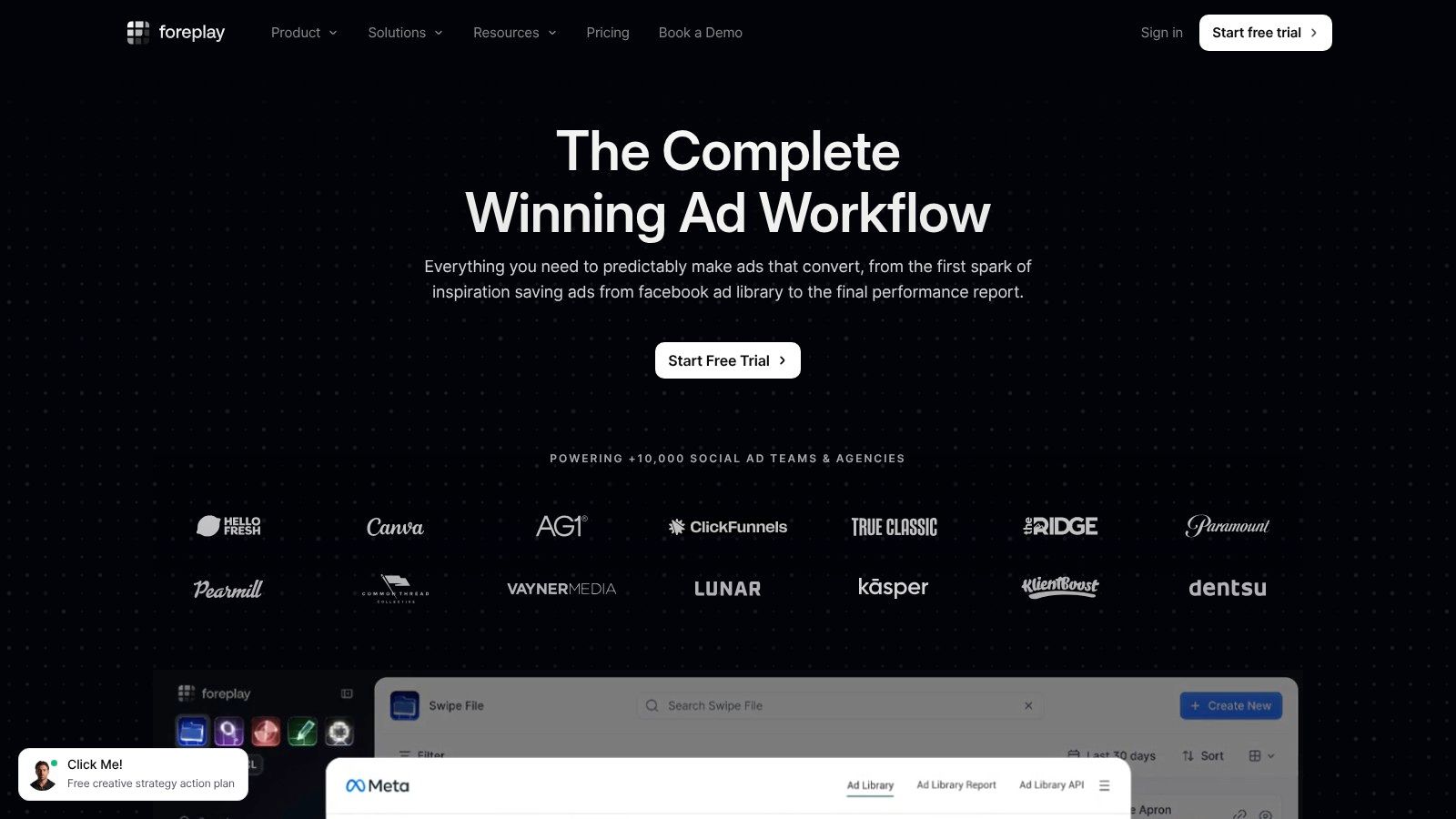
That combination fits agencies and creative teams better than analysts. The value sits in the library your team builds: which hooks you've seen, which angles are tired, which landing pages keep reappearing across a category.
Why saving beats scrolling
Adoption data explains the gap between access and use. Business-intelligence tools report average user adoption around 59%, and only 25% of employees use BI software daily, with regular use at 44% in smaller firms against 16% at large enterprises (G2). A small team with an organised swipe file beats a big one sitting on twelve unused licences.
- Strong: organising and sharing creative references across a team.
- Weak: store traffic, product catalogues and pricing intelligence.
- Watch: entry-level plans exclude competitor tracking, and team depth costs more.
Fit: a creative workflow where the research output is a brief, not a dashboard. Limit: it won't tell you what a competitor's traffic or catalogue is doing.
10. BigSpy
BigSpy spreads across ad networks rather than going deep on one. Search covers supported networks with creative filters and downloads, tracking and analysis sit on paid tiers, and a limited free plan lets you test the basics before paying (BigSpy).
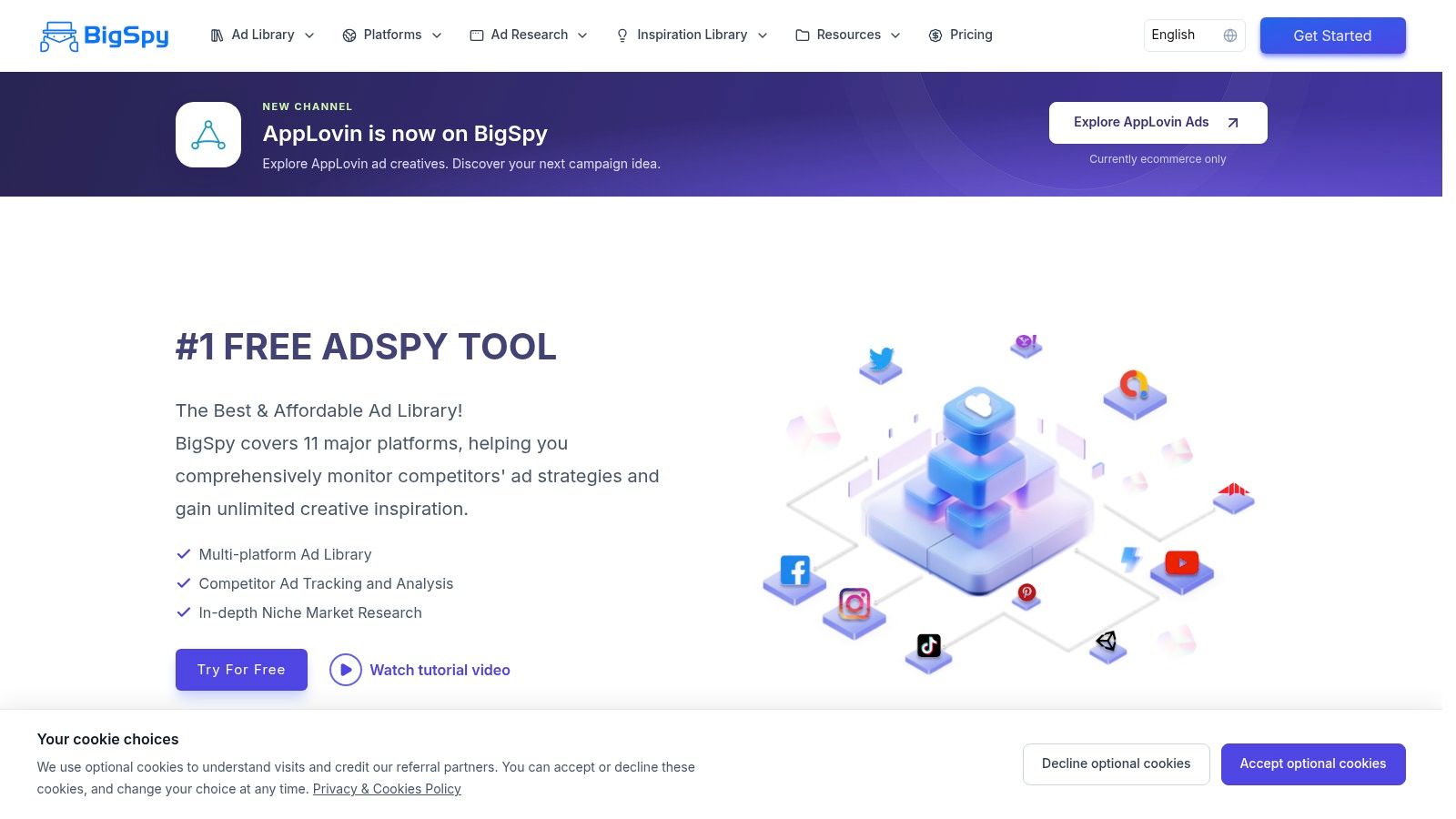
When a tool covers many networks, the first question is what coverage you actually get on the plan you're buying.
That's the honest constraint of multi-network research. Confidence in marketing decision data is already shaky: 45% of surveyed CMOs across the US, UK, Germany, Austria and Switzerland said the data behind their marketing decisions was incomplete, inaccurate or outdated (Adverity). Ad libraries add their own gaps on top, because each network defines an ad record differently.
- Fit: collecting creative examples from channels outside Meta, where your competitors run.
- Limit: free-plan searches are restricted, network access depends on tier, and store-level context is thin.
- Watch: treat creative counts and screenshots as samples, never as inventory counts.
If your competitors advertise mainly on Facebook and Instagram, a Meta-focused workspace gives you more per hour of research than a broad network search.
How the 10 competitor analysis tools differ by data coverage, store-level research, and team features
| Item | Ad platform coverage | Store or traffic data | Team features | Best for |
|---|---|---|---|---|
| AdLibrarySpy | Meta ads: Facebook and Instagram | Store directory, traffic history, products, technology, and visitor countries | Shared workspaces, weekly reports, and competitor alerts; free | Recommended for free ecommerce and Meta-ad research in one workspace |
| Meta Ad Library | Meta platforms | No store or traffic analysis | No team features specified | Checking active Meta ads from a first-party source |
| Similarweb | No ad creative library; includes paid-search insights | Website traffic estimates, benchmarking, and market research | No team features specified | Website traffic and market-level competitor research |
| Semrush | Paid-search competitor insights | Domain and search visibility research | Plans for individuals and larger teams | SEO and paid-search competitor research |
| Ahrefs | No social-ad coverage specified | Competitor website, keyword, and backlink research | No team features specified | SEO, backlink, and content research |
| SpyFu | Google search ads | Organic and paid keyword research; historical domain data on qualifying plans | Saved projects for organizing research | Google Ads and search competitor research |
| Minea | Meta and TikTok ads | Product and shop research; limited broad traffic insight | Saved collections; features vary by plan | Ecommerce product and ad discovery |
| WinningHunter | Meta, TikTok, and Pinterest on eligible plans | Store, product, and TikTok Shop research | Brand tracking; AI and integrations depend on plan | Ecommerce store, product, and ad research |
| Foreplay | Creative database; competitor Meta-ad tracking on higher plans | No broad store or traffic analysis | Swipe files, boards, and shareable briefs | Creative research and collaboration |
| BigSpy | Multiple supported networks; coverage varies by plan | No detailed store or traffic data | No team features specified | Searching and collecting ad creatives across channels |
Match the Tool to the Question You Are Actually Asking
A rival's new Meta campaign, a sudden traffic increase, and a shift in search visibility call for different evidence. Choose the tool based on what it can observe, then decide what that evidence can and cannot establish.
For ad creative, Meta Ad Library provides records for Meta platforms. Foreplay supports organizing creative research into team briefs, while BigSpy offers coverage across other networks. Minea focuses on product-led ad discovery. The trade-off is coverage: a tool focused on one advertising ecosystem will not answer questions about every channel.
For store and traffic research, Similarweb supports traffic benchmarking, WinningHunter helps with shop discovery, and AdLibrarySpy brings store details and live Meta ads together. Its store dossiers include measured traffic, products, apps and pixels, and similar stores. The figures are signals for comparison, not private sales data.
For search research, Semrush covers a broad set of search questions, Ahrefs focuses on backlinks, and SpyFu provides paid-search history. Traffic and keyword data can help explain where a rival attracts visitors, but those tools do not replace checking the actual landing pages or ads.
Before paying for any tool, check how it labels data sources and reporting periods, whether records can be exported, and how usage limits affect a five-competitor workflow. A trial using your actual shortlist is more useful than a generic product demonstration.
A second tool makes sense when the first leaves a specific research question unanswered. For example, a traffic platform can show that a rival is growing, while a keyword tool can help identify search terms associated with that visibility. Add a subscription only if the missing evidence changes a decision you need to make.
The global competitive-intelligence market was estimated at about $50.87 billion in 2024 and is projected to reach $122.77 billion by 2033, with software platforms making up 68.23% of the 2024 market (competitor analysis market statistics). With tools making overlapping claims, their data coverage and limits are more useful selection criteria than feature counts.
Turn each useful finding into a test. Write down the hypothesis suggested by a competitor's ad, product, or traffic pattern, then compare it with your own results. A saved example is a reference; a measured test helps guide a decision.
If your next question is about product imagery rather than rivals, see this comparison of product photography software tools.
AdLibrarySpy offers a free workspace for researching stores, with traffic, products, apps and pixels, and live Meta ads shown in store dossiers. You can filter stores by niche, country, traffic, growth, ad activity, and tech stack, then track competitors through snapshots of traffic and ad activity. AdLibrarySpy is suited to store-level research; its advertising coverage is limited to Meta platforms.
More guides
Try AdLibrarySpy free
Search millions of stores and real Meta ads. No card, no trial — sign up with just your email.