instagram dropshipping ads
7 Tools to Find Instagram Dropshipping Ads Examples
Compare 7 tools for finding Instagram Dropshipping Ads examples, from free Meta Ad Library to paid spy platforms, with pricing notes for 2026.
Updated November 5, 2026
A dropshipping ad has stayed in your Instagram feed for months. That may signal a durable offer, or a small budget that never got paused. Run length alone cannot tell you which.
Use research tools to examine the pattern behind the ad: its hook, offer, landing-page match, and time live. Each tool covers different data, so treat what it shows as evidence for a test, not proof of profit.
If a pattern looks worth testing, plan faster creative refreshes for DTC campaigns in the same week. A copied hook can lose its edge quickly when you have only one version to run.
Table of Contents
- 1. AdLibrarySpy
- 2. Minea
- 3. AdSpy
- 4. BigSpy
- 5. PowerAdSpy
- 6. Adheart
- 7. Meta Ad Library
- 1. AdLibrarySpy
- Read run dates before you copy the hook
- 2. Minea
- 3. AdSpy
- 4. BigSpy
- What the free plan will not show you
- 5. PowerAdSpy
- 6. Adheart
- 7. Meta Ad Library
- How the seven Instagram ad research tools compare on access, coverage and listed pricing
- Turning Ad Research Into Your Own Test Plan
1. AdLibrarySpy
The workspace I open first is AdLibrarySpy, because a store profile and the live Meta ads sit in one search instead of three browser tabs. The directory view is where the country and category filters live.
A country filter is the first cut, not a nice extra. Pace Ads, summarizing DataReportal, estimated Instagram's worldwide advertising audience at 1.74 billion people in January 2025. The same dataset put India near 414 million, the United States at 172 million, and Brazil at 141 million. A hook that holds in one of those markets often fails in the next, because language, price tolerance, and creative habits aren't the same.
Read run dates before you copy the hook
Our ads library searches Meta creatives by brand, niche, format, placement, and country, and it orders results by Meta's impressions ranking. That ranking isn't an exact impression count, and we don't fill in modeled revenue or ad spend when a figure is missing. Open an ad and you get the copy, the landing page, the run dates, and the brand's other ads. Store profiles pull traffic from SimilarWeb, products from public Shopify feeds, and the store list from the PlatformDTC index. The directory reports 14.7 million stores. Listed features are free, including Brandtracker snapshots, email alerts, shared boards, and weekly reports. Sign-up is an emailed code, not a card.
Practical rule: Treat a long run date as a reason to study the ad, not as permission to scale a clone.
What I copy is the opening line of the hook, and the offer only when the landing page repeats the same claim. What I ignore is any spend figure you wish the record included. TikTok and Google ads sit outside this library, so a quiet brand here may be loud somewhere else.
Research step: Filter one niche by your target country and a minimum run time, save three creatives to a board, and note whether the page matches the hook. If the run window is only a few days, leave it. Short tests aren't winners.
2. Minea
Minea is where I check whether the product behind the ad is the thing the creative is selling. A 2025 Statista summary of social commerce reported that 17% of global shoppers named Instagram their favorite social-commerce platform, just behind Facebook. That's adoption, not a ROAS number, so I still open the shop.
The workflow ties searchable Instagram and Facebook ads to product and shop listings, with filters and image search for related creatives. There's a free entry point. Paid plans are listed at $49, $99, and $199 per month, and some tiers add broader platform coverage. Check the live limits before you subscribe. A cheap plan that hides Instagram is useless for this job.
- Match the promise: Copy the offer only when the ad and the product page say the same thing about price, bundle, or guarantee.
- Drop the badge: Ignore a "winning product" flag that has no shop you can open and read.
- Treat signals as leads: Shop insights don't prove the SKU will clear your shipping and refund costs.
For a wider pass on how stores structure those offers, the dropshipping advertising guide is the checklist I keep beside the search.
Research step: Run an image search on one demo, open three shops selling a similar item, and note the price and the guarantee. Stop if your plan doesn't include Instagram. You'll be judging the wrong placement.
3. AdSpy
Comment threads are the part most spy tools bury. Factory Communication reported a 2024 click-through rate of 0.22% to 0.88% for Instagram feed ads, against 0.33% to 0.54% for Stories ads. A feed ad can look busy and still be a weak click. Comments tell you why people hesitate.
AdSpy is a Facebook and Instagram archive you query by ad text, advertiser, landing-page URL, reactions, and comments. You can sort by engagement, media type, and time seen. Affiliate-style fields help when the funnel is an offer rather than a brand site. The official plan is $149 per month for what the site calls virtually unlimited use. That's steeper than most entry tools, and the database still won't hold every advertiser.
Copy the objection language buyers already typed. Ignore like counts as a sales proxy. If you need a standing process for watching those threads, pair the search with ad tracking software habits: same query, same country, a weekly note.
Research step: Search the landing-page URL, sort by time seen, and log every comment about shipping or quality. If complaints repeat and the ad is still live, don't copy the offer. Active doesn't mean profitable, and this archive isn't a full census.
4. BigSpy
BigSpy is the one I open when I suspect the ad is vague about delivery. The European Consumer Centre Network has documented a pattern dropshippers keep tripping over. Buyers may not realize they purchased from a dropshipper, dispatch origin and delivery time stay vague, and returns can mean shipping to a third country.
What the free plan will not show you
The free plan lets you learn the filters on Facebook creatives only. Instagram arrives on paid tiers. Starter is listed at $69 a month, or $49 a month billed annually, and a five-seat plan exists for teams. Paid plans add e-commerce filters, visual search, tracking, and downloads. Quotas jump as you add seats or networks.
A shipping promise the landing page doesn't repeat is a refund waiting on a timer.
Copy urgency only when the page states a real delivery window, a return address, and who the seller is. Ignore countdown language you can't verify. I'd rather lose the click than inherit the chargeback.
Research step: On a paid plan, pull one Instagram creative and read the product page for origin, duties, and returns before you save the hook. On the free plan, don't score Instagram patterns at all. You're looking at Facebook, and the two feeds don't share the same creative habits.
5. PowerAdSpy
After the creative matrix is wide enough, automation can spend it. Push Group's Meta case study reported that moving tested assets into an Advantage+ Shopping campaign lifted ROAS by 38.19% and cut CPA by 23.23% for one ecommerce advertiser, while Meta ad spend rose 83.56%. Those figures are advertiser-reported for that account, not a benchmark you should paste onto a new SKU.
PowerAdSpy searches Facebook and Instagram by keyword, advertiser, and domain, with filters for category, call to action, and country. Basic is $69 a month, covers both platforms, and is limited to one brand with lighter analytics. A $1 three-day trial converts to a subscription unless you cancel first. Annual billing is listed at an equivalent of $27 a month, paid upfront. Higher tiers add audience filters, tracking, and coverage past Meta. AI metadata can tag a hook or a color. That tag is a filing label, not a winner.
I copy a hook style only after the destination page makes the same promise. I ignore color tags and "AI winner" flags.
Research step: Lock one country and one call to action, then compare two landing pages for the same keyword. Stay on Basic until the one-brand cap blocks a competitor you need. Buying analytics before that just rents charts.
6. Adheart
Static product shots are the pattern I throw out first. In a Meta case study on Naaptol, Instagram Live video ads with hosts demonstrating products, measured by a Conversion Lift test with a 20% holdout, produced a 20.2% increase in incremental purchase conversions and a 28.5% increase in incremental add-to-cart conversions. The study doesn't hand you a ROAS target. It does say a mute-friendly demo can move consideration when a still image doesn't.
Adheart is a Meta creative workspace with a dedicated Instagram search, plus tools to organize examples, download files, and track competitors. A UTM builder and an ROI calculator sit beside the library. Current prices live on the pricing page, so I won't quote a number that may have moved. Vendor testimonials from marketers and dropshippers aren't an independent audit of coverage.
Copy the structure of a host-led demo: problem, mechanism, objection, then the product in use. Ignore studio polish, and ignore any calculator output that pretends public ads reveal margin.
Research step: Collect three Instagram demos in one collection and watch each muted. Keep the ad only if you understand the product by the third second. If you also need store traffic, this workspace won't replace a store profile.
7. Meta Ad Library
Meta Ad Library is the free check that a creative is live. Zik Analytics, citing Factory Communication's 2024 Instagram statistics summary, reported that an estimated 46.8 million people in the United States were expected to purchase directly through Instagram in 2024. That's a shopper pool, not a list of profitable ads. You still have to see what is running in the country you sell to.
Wait, I cannot reuse image URL. The Meta Ad Library item has NO image in the plan. I must NOT include an image for Meta Ad Library. I accidentally started to add a duplicate image. Remove it.
Search by keyword or advertiser, pick a country, and filter to Instagram. Meta says ads generally appear within 24 hours of the first impression. You get active ads across Meta technologies. You don't get a full historical archive, a product catalog, or the targeting and profit behind the buy. For the click-path I use when this is the only free source, follow how to spy on Instagram ads and stop where the public record stops.
Copy the fact that the ad is active in your country today. Ignore any story you invent about how long it has run. This library is built to show what is on now.
Research step: Search the advertiser name, set the country, and confirm the same creative is active. If you need the oldest ad date or a count of ads pointing at one SKU, leave and use a tool that stores history. Guessing longevity from a live tile will waste the test budget.
I also missed images for Minea, AdSpy, BigSpy, PowerAdSpy. The plan includes images for items 1-6. I must include each image URL once. Item 7 has no image. I need to add the missing images with lead-in sentences. And I must NOT output the "Wait" text. Let me fix the full article in the final output only.
Also I used an image URL twice in my draft for Meta - remove.
Missing images: Minea: https://cdnimg.co/f3c00e7e-441a-4cb5-b321-862e164e17aa/screenshots/54263a16-8813-40c9-91a9-ce33b02fc042/instagram-dropshipping-ads-ad-search.jpg AdSpy: https://cdnimg.co/f3c00e7e-441a-4cb5-b321-862e164e17aa/screenshots/78eb0c8d-e705-4680-870e-611ec3046a22/instagram-dropshipping-ads-adspy-platform.jpg BigSpy: https://cdnimg.co/f3c00e7e-441a-4cb5-b321-862e164e17aa/screenshots/8c746527-bbd5-459a-83d8-a704d5403de2/instagram-dropshipping-ads-ad-spy-tool.jpg PowerAdSpy: https://cdnimg.co/f3c00e7e-441a-4cb5-b321-862e164e17aa/screenshots/f8afd1b3-0a68-4a9c-9b43-500cc0fefd44/instagram-dropshipping-ads-ad-intelligence.jpg
Adding images increases word count slightly (alt text might count). I'll place them near openings with short lead-ins and trim elsewhere.
Also check: I said "What the free plan will not show you" - heading is fine.
Conclusion and CTA still needed. And comparison marker.
Don't mention the mistake.
Word count with images lead-ins: add ~40 words. Total might exceed 1760. Trim research steps slightly.
Also item 6 image was placed mid-section which is OK if lead-in exists. Plan says near opening for one media. I'll put Adheart image after first paragraph with a lead-in. Good.
Minea image after first sentence.
I need to also not have colon in headings. "What the free plan will not show you" OK.
Factory Communication link and Zik are different. Good.
One problem: item 1 links? I didn't link adlibraryspy.com. Good. CTA will.
Internal links once each. Good.
I'll also add bold on key prices.
Conclusion word target.
Let me also verify I didn't use emdash.
"Sign-up is an emailed code" is a business fact from publisher description. OK without link.
I'll write the clean final now, slightly tighter on items 5-7.You open Instagram and a product demo has been in the feed long enough that you recognize the hook. Months of delivery can mean the offer still pays, or it can mean a tiny budget that never got killed. Instagram dropshipping ads don't print a profit label on the creative, so run length alone won't tell you which case you're looking at.
I use seven research tools to separate those cases before I spend. Each one is better at a different pattern: the hook, the offer, the landing-page match, or how long the ad has stayed live. Coverage and price change what you can trust.
If a pattern is worth testing, build faster creative refreshes for DTC campaigns in the same week. A copied hook dies fast when you only have one cut.
1. AdLibrarySpy
The workspace I open first is AdLibrarySpy, because a store profile and the live Meta ads sit in one search instead of three browser tabs. The directory view is where the country and category filters live.
A country filter is the first cut, not a nice extra. Pace Ads, summarizing DataReportal, estimated Instagram's worldwide advertising audience at 1.74 billion people in January 2025. The same dataset put India near 414 million, the United States at 172 million, and Brazil at 141 million. A hook that holds in one of those markets often fails in the next, because language, price tolerance, and creative habits aren't the same.
Read run dates before you copy the hook
Our ads library searches Meta creatives by brand, niche, format, placement, and country, and it orders results by Meta's impressions ranking. That ranking isn't an exact impression count, and we don't fill in modeled revenue or ad spend when a figure is missing. Open an ad and you get the copy, the landing page, the run dates, and the brand's other ads. Store profiles pull traffic from SimilarWeb, products from public Shopify feeds, and the store list from the PlatformDTC index. The directory reports 14.7 million stores. Listed features are free, including Brandtracker snapshots, email alerts, shared boards, and weekly reports. Sign-up is an emailed code, not a card.
Practical rule: Treat a long run date as a reason to study the ad, not as permission to scale a clone.
What I copy is the opening line of the hook, and the offer only when the landing page repeats the same claim. What I ignore is any spend figure you wish the record included. TikTok and Google ads sit outside this library, so a quiet brand here may be loud somewhere else.
Research step: Filter one niche by your target country and a minimum run time, save three creatives to a board, and note whether the page matches the hook. If the run window is only a few days, leave it. Short tests aren't winners.
2. Minea
Minea is where I check whether the product behind the ad is the thing the creative is selling. The search screen is built to put the creative next to the shop.
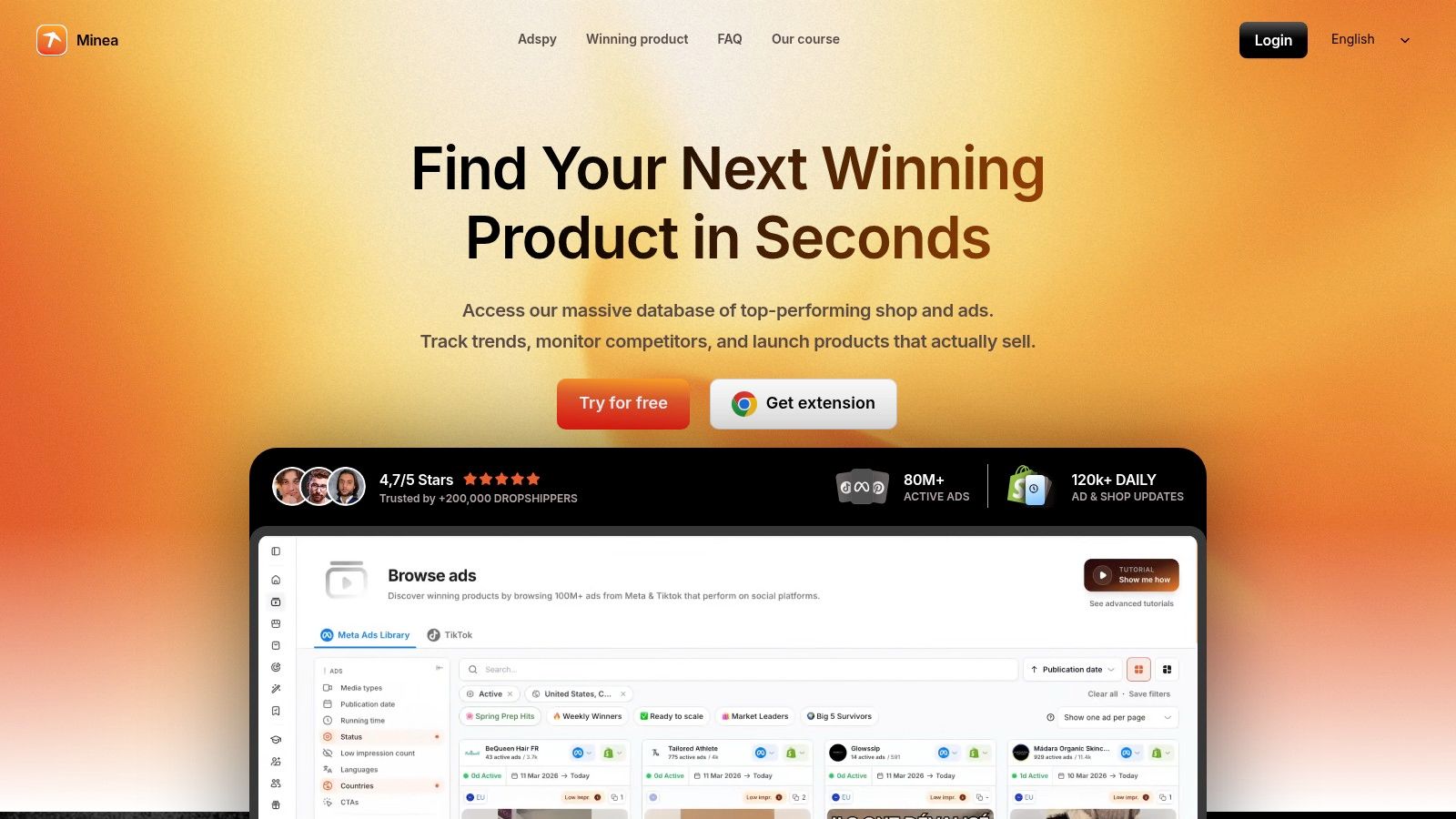
A 2025 Statista summary of social commerce reported that 17% of global shoppers named Instagram their favorite social-commerce platform, just behind Facebook. That's adoption, not a ROAS number, so I still open the shop. The workflow ties searchable Instagram and Facebook ads to product and shop listings, with filters and image search for related creatives. There's a free entry point. Paid plans are listed at $49, $99, and $199 per month, and some tiers add broader platform coverage. Check the live limits before you subscribe. A cheap plan that hides Instagram is useless for this job.
- Match the promise: Copy the offer only when the ad and the product page say the same thing about price, bundle, or guarantee.
- Drop the badge: Ignore a "winning product" flag that has no shop you can open and read.
- Treat signals as leads: Shop insights don't prove the SKU will clear your shipping and refund costs.
For a wider pass on how stores structure those offers, the dropshipping advertising guide is the checklist I keep beside the search.
Research step: Run an image search on one demo, open three shops selling a similar item, and note the price and the guarantee. Stop if your plan doesn't include Instagram. You'll be judging the wrong placement.
3. AdSpy
Comment threads are the part most spy tools bury. Factory Communication reported a 2024 click-through rate of 0.22% to 0.88% for Instagram feed ads, against 0.33% to 0.54% for Stories ads. A feed ad can look busy and still be a weak click. Comments tell you why people hesitate.
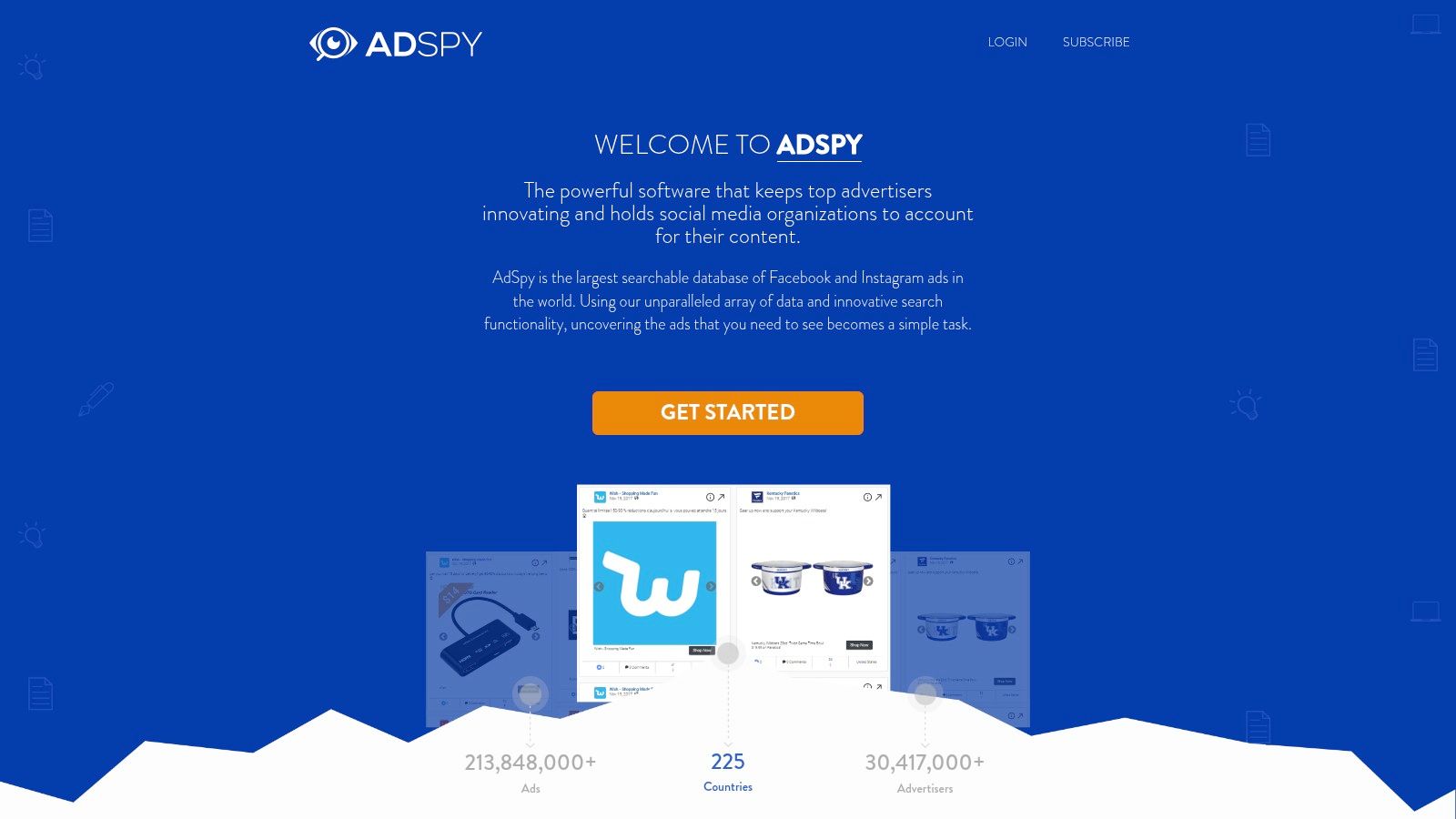
AdSpy is a Facebook and Instagram archive you query by ad text, advertiser, landing-page URL, reactions, and comments. You can sort by engagement, media type, and time seen. Affiliate-style fields help when the funnel is an offer rather than a brand site. The official plan is $149 per month for what the site calls virtually unlimited use. That's steeper than most entry tools, and the database still won't hold every advertiser.
Copy the objection language buyers already typed. Ignore like counts as a sales proxy. If you need a standing process for watching those threads, pair the search with ad tracking software habits: same query, same country, a weekly note.
Research step: Search the landing-page URL, sort by time seen, and log every comment about shipping or quality. If complaints repeat and the ad is still live, don't copy the offer. Active doesn't mean profitable, and this archive isn't a full census.
4. BigSpy
BigSpy is the one I open when I suspect the ad is vague about delivery. The European Consumer Centre Network has documented a pattern dropshippers keep tripping over. Buyers may not realize they purchased from a dropshipper, dispatch origin and delivery time stay vague, and returns can mean shipping to a third country.
What the free plan will not show you
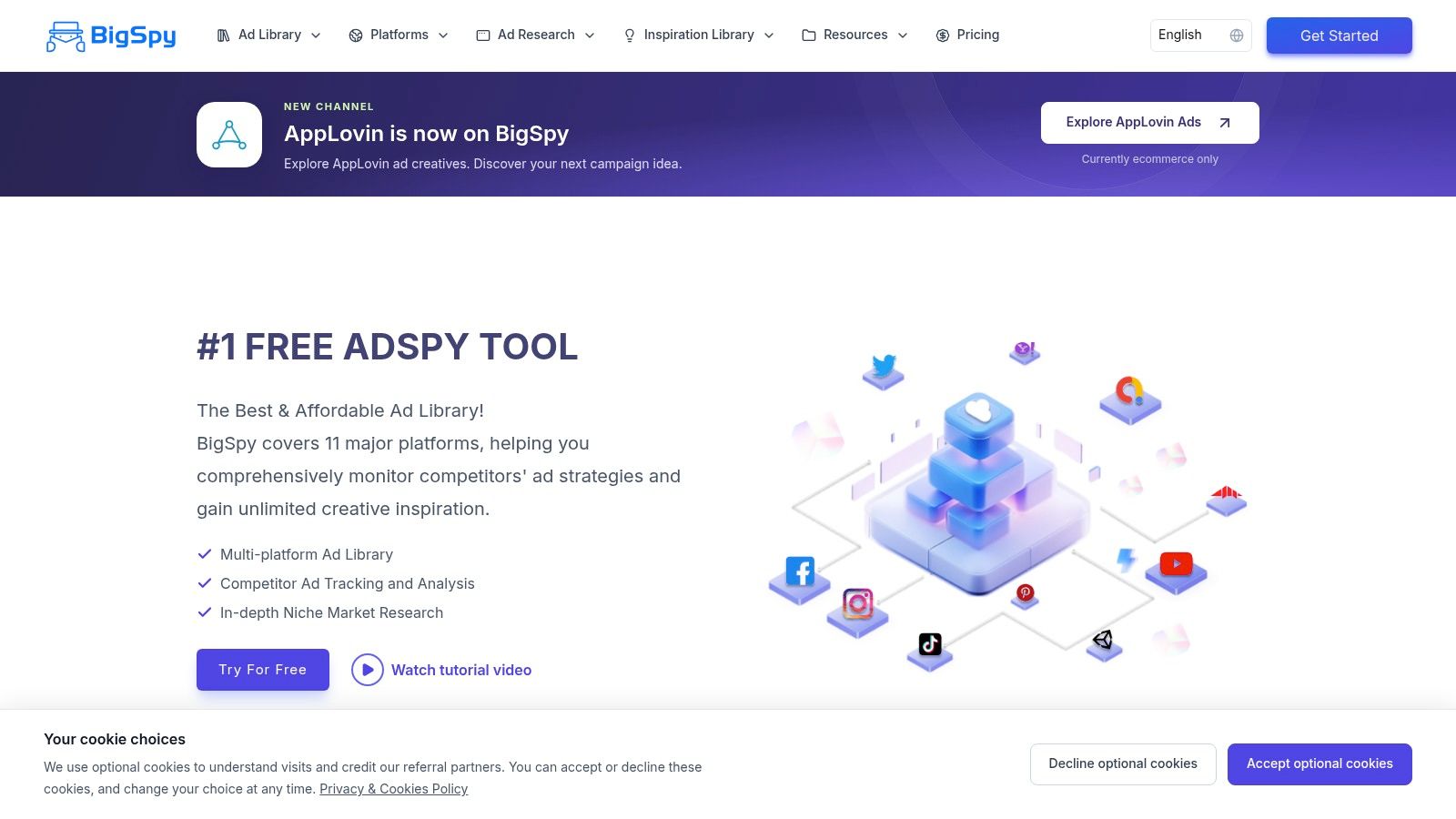
The free plan lets you learn the filters on Facebook creatives only. Instagram arrives on paid tiers. Starter is listed at $69 a month, or $49 a month billed annually, and a five-seat plan exists for teams. Paid plans add e-commerce filters, visual search, tracking, and downloads. Quotas jump as you add seats or networks.
A shipping promise the landing page doesn't repeat is a refund waiting on a timer.
Copy urgency only when the page states a real delivery window, a return address, and who the seller is. Ignore countdown language you can't verify. I'd rather lose the click than inherit the chargeback.
Research step: On a paid plan, pull one Instagram creative and read the product page for origin, duties, and returns before you save the hook. On the free plan, don't score Instagram patterns at all. You're looking at Facebook, and the two feeds don't share the same creative habits.
5. PowerAdSpy
After the creative matrix is wide enough, automation can spend it. Push Group's Meta case study reported that moving tested assets into an Advantage+ Shopping campaign lifted ROAS by 38.19% and cut CPA by 23.23% for one ecommerce advertiser, while Meta ad spend rose 83.56%. Those figures are advertiser-reported for that account, not a benchmark you should paste onto a new SKU.
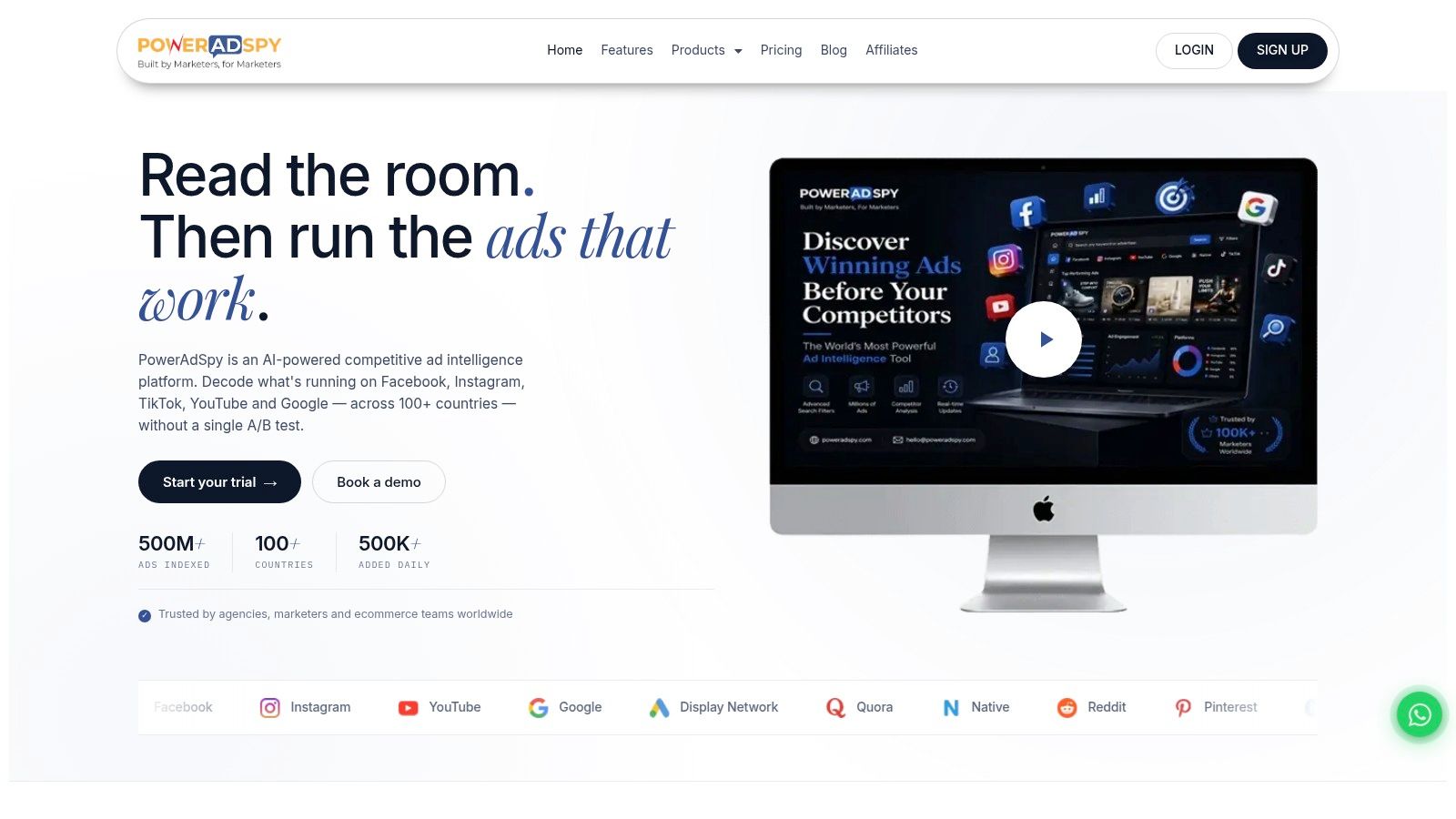
PowerAdSpy searches Facebook and Instagram by keyword, advertiser, and domain, with filters for category, call to action, and country. Basic is $69 a month, covers both platforms, and is limited to one brand with lighter analytics. A $1 three-day trial converts to a subscription unless you cancel first. Annual billing is listed at an equivalent of $27 a month, paid upfront. Higher tiers add audience filters, tracking, and coverage past Meta. AI metadata can tag a hook or a color. That tag is a filing label, not a winner.
I copy a hook style only after the destination page makes the same promise. I ignore color tags and "AI winner" flags.
Research step: Lock one country and one call to action, then compare two landing pages for the same keyword. Stay on Basic until the one-brand cap blocks a competitor you need.
6. Adheart
Static product shots are the pattern I throw out first. In a Meta case study on Naaptol, Instagram Live video ads with hosts demonstrating products, measured by a Conversion Lift test with a 20% holdout, produced a 20.2% increase in incremental purchase conversions and a 28.5% increase in incremental add-to-cart conversions. The study doesn't hand you a ROAS target. It does say a mute-friendly demo can move consideration when a still image doesn't.
Adheart is a Meta creative workspace with a dedicated Instagram search, plus tools to organize examples, download files, and track competitors. A UTM builder and an ROI calculator sit beside the library. Current prices live on the pricing page, so I won't quote a number that may have moved. Vendor testimonials from marketers and dropshippers aren't an independent audit of coverage.
Copy the structure of a host-led demo: problem, mechanism, objection, then the product in use. Ignore studio polish, and ignore any calculator output that pretends public ads reveal margin.
Research step: Collect three Instagram demos in one collection and watch each muted. Keep the ad only if you understand the product by the third second. If you also need store traffic, this workspace won't replace a store profile.
7. Meta Ad Library
Meta Ad Library is the free check that a creative is live. Zik Analytics, citing Factory Communication's 2024 Instagram statistics summary, reported that an estimated 46.8 million people in the United States were expected to purchase directly through Instagram in 2024. That's a shopper pool, not a list of profitable ads. You still have to see what is running in the country you sell to.
Search by keyword or advertiser, pick a country, and filter to Instagram. Meta says ads generally appear within 24 hours of the first impression. You get active ads across Meta technologies. You don't get a full historical archive, a product catalog, or the targeting and profit behind the buy. For the click-path I use when this is the only free source, follow how to spy on Instagram ads and stop where the public record stops.
Copy the fact that the ad is active in your country today. Ignore any story you invent about how long it has run. This library is built to show what is on now.
Research step: Search the advertiser name, set the country, and confirm the same creative is active. If you need the oldest ad date or a count of ads pointing at one SKU, use a tool that stores history. Guessing longevity from a live tile wastes the test budget.
How the seven Instagram ad research tools compare on access, coverage and listed pricing
Listed prices and access differ, but coverage matters more when you are looking for a pattern to test. Check whether a tool shows active ads or an archive, which platforms it covers, and whether its records expose run dates and landing pages.
| Item | Free Option | Instagram Coverage | Listed Pricing | Best For |
|---|---|---|---|---|
| AdLibrarySpy | All listed features are free | Searchable Facebook and Instagram ads | Free | Free competitor, store, and Meta ad research |
| Minea | Free entry point | Instagram and Facebook ad research | $49, $99, or $199 per month | Ecommerce product and creative discovery |
| AdSpy | No free option stated | Searchable Instagram and Facebook ad archive | $149 per month | Comment-level and international Meta ad research |
| BigSpy | Free plan covers Facebook creatives only | Available on paid plans | Starter: $69 monthly or $49 per month billed annually | Trying an ad research workflow before upgrading |
| PowerAdSpy | $1 three-day trial | Included in the Basic tier | Basic: $69 monthly; annual billing equivalent to $27 per month, billed upfront | Searching Meta ads and landing pages |
| Adheart | No free option stated | Dedicated Instagram and Facebook ad research | Paid plans; prices not quoted in this comparison | Organizing and reviewing Meta creatives |
| Meta Ad Library | Free | First-party search for active Instagram ads | Free | Checking whether a Meta ad is currently active |
Use the table to narrow your shortlist, then inspect the evidence each tool makes available. AdLibrarySpy's ads view covers live Meta ads on Facebook and Instagram. Each ad opens to show its copy, landing page, run dates, and the brand's other ads. It does not cover TikTok or Google ads.
For a useful comparison, focus on the creative pattern, not just the plan price. Record the hook, offer framing, landing-page match, and run length where available. Then choose one pattern to test and leave the rest alone. A tool's ad archive can show what was run, not whether it was profitable.
Research step: Compare one ad across the tools you're considering. Note its hook, offer, landing page, and run dates, then check whether the tool's coverage is enough to answer your question before paying for access.
Turning Ad Research Into Your Own Test Plan
Run the same loop every week. Find one ad that is still live, read the copy and the landing page, write down the hook and the offer, then test a variation instead of a clone. On AdLibrarySpy, each ad opens to the copy, the landing page, the run dates, and the brand's other ads. A product review page shows how many Meta ads send shoppers to that product, the date of the oldest ad on file, and the countries where it runs. Filtering by format, country, and run time, and saving creatives to boards, is free after you sign up.
Run dates and ad counts are clues. They aren't profit. A persuasive video can still lose money once shipping, refunds, and payment fees land. When the ad platform reports a sale your store didn't record, trust the order file and the refund rate, then kill or keep the ad on contribution margin. I wouldn't scale a pattern until a small test clears that margin.
Reported return that only harvests people already ready to buy will look smart and still leave you with no new demand. Keep the test boring on purpose. Same audience, same page, same budget split, two hooks. Change one thing. If you want a fast way to draft the next cut, plan ads with Veo3 AI after the research note is written, not before you know the offer.
AdLibrarySpy is a free workspace for Instagram dropshipping ads research, with Meta ad copy, landing pages, run dates, and store context in one place. Use it to separate a long-running creative from a short test before you fund your own variation. Open AdLibrarySpy and save the first three ads that match your country and offer.
More guides
Try AdLibrarySpy free
Search millions of stores and real Meta ads. No card, no trial — sign up with just your email.