drop shipping advertising
Drop Shipping Advertising: Channels That Actually Convert
Drop shipping advertising explained: how Meta, TikTok, and Google channels work, what creative converts, and how to judge results when attribution is
Updated October 23, 2026
Take an example order: $38.19 to acquire it, $71.69 in revenue. The gap looks comfortable until product cost, payment fees, shipping, refunds, and support take their share; what remains is contribution margin, and it decides whether spend can scale.
That is why channel choice belongs downstream of product economics. A beauty bundle, a bulky home item, and a low-price phone accessory do not have the same allowable CPA, even if the same benchmark CPMs apply. Treat competitor ads as hypotheses worth testing, not evidence of profit. The account survives when every scaled campaign clears its own margin line.
Table of Contents
- Why Drop Shipping Advertising Lives or Dies on Contribution Margin
- How Social Advertising Became the Dropshipping Engine
- Calculating Your Maximum Allowable CPA Before You Spend
- Comparing Meta, TikTok, and Google for Dropshipping Campaigns
- Creative Elements That Move Dropshipping Ad Performance
- Reading Competitor Ads Without Fooling Yourself
- Choosing How to Research Competitor Advertising
- Your First Week of Drop Shipping Advertising
Why Drop Shipping Advertising Lives or Dies on Contribution Margin
A campaign can report healthy delivery and still lose money on the order that matters. As noted earlier, the ecommerce benchmark cited earlier set a high bar for acquisition economics, so the useful read is directional: what did the market pay for reach, clicks, and orders, and what would those costs do to your margin if your store performs near the middle rather than at the lucky edge?
Treat each platform metric as one witness in a longer chain. CPM describes auction pressure. CTR shows whether the creative earns attention, yet attention can arrive from buyers with weak intent. Conversion rate and CPA begin to price the order path, while average order value decides how much room exists after product cost, payment fees, shipping, refunds, and support. Platform-reported ROAS stays directional because attribution settings, view-through credit, and blended catalog revenue can flatter a campaign that still fails after fulfillment.
The whole order path matters
For a dropshipper, a low supplier cost is only the first line of the equation. The customer still has to move from impression to click, product page, checkout, delivery, and a satisfactory post-purchase experience. If the promise says fast delivery and the supplier ships in weeks, the ad has manufactured a refund. If the product page avoids sizing, warranty, or customs questions, cheap clicks scale doubt.
That is why category economics belong in the media plan before channel rules of thumb. A low-ticket impulse item cannot absorb the same acquisition cost as a replenishable bundle, a niche accessory with fewer substitutes, or a product that reliably creates a second purchase. Sort products by order value, repeat potential, delivery risk, refund exposure, and creative clarity; the category tells you which benchmarks are dangerous to copy.
The operating rule: Scale only when contribution margin after acquisition stays positive across refunds and support; CTR alone cannot approve spend.
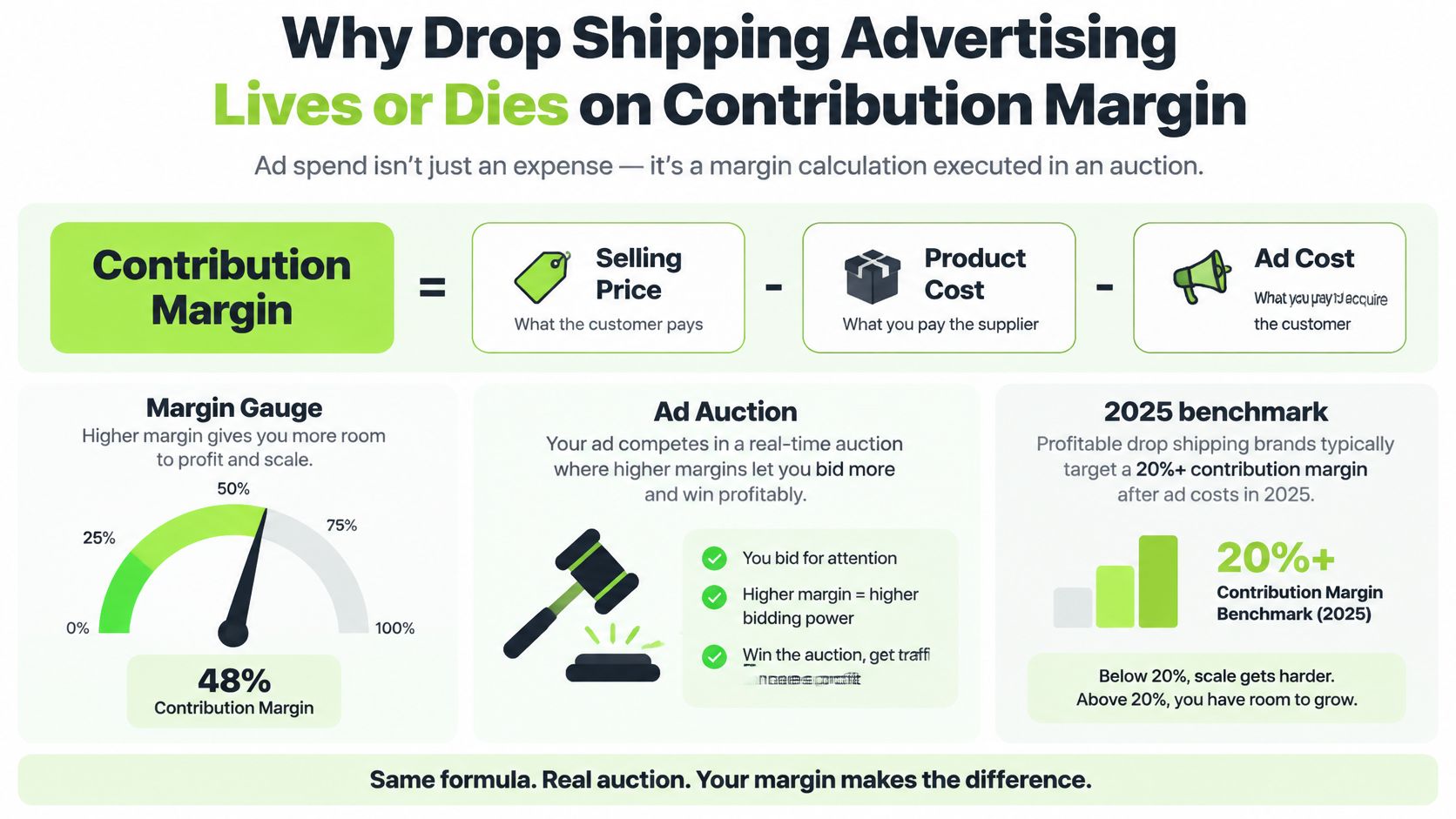
Use the DTC ecommerce guide to organize that analysis around the store, offer, and customer journey before you compare platforms. The channel choice becomes clearer once each order has a maximum allowable CPA written down.
How Social Advertising Became the Dropshipping Engine
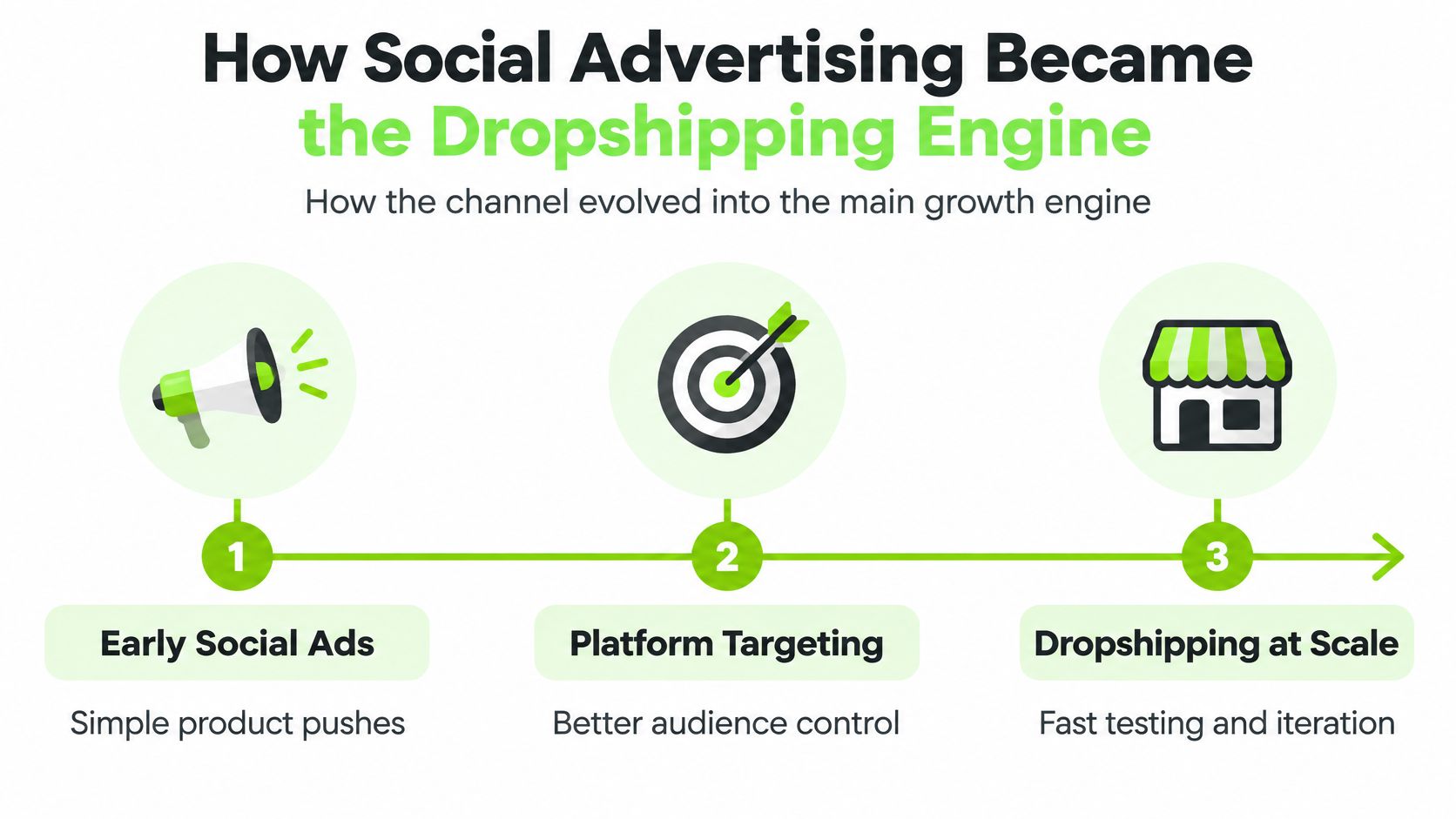
Dropshipping advertising grew out of a change in how businesses could reach people online. Search and display advertising generally depended on placing messages around queries or content. Social advertising added identity, audience selection, and social behavior to the buying process.
Facebook formally introduced its advertising system on November 6, 2007, combining business Pages, targeted ads, and audience-insight tools. Businesses could select audiences and connect social actions, such as a friend's purchase or restaurant review, to advertising messages. Facebook reported that more than 100,000 new Pages launched on the day of the announcement. Facebook's announcement captures the early commercial shift: businesses weren't only buying broad exposure, they were using a platform where audience behavior and social context could shape promotion.
That structure suited a business model built around acquiring customers without operating physical stores or holding substantial inventory. A merchant could put a product offer in front of a defined audience, observe the response, and use those signals to decide what to test next. The key advantage wasn't that ads appeared in a social feed. It was that targeting, social recommendations, and measurable interaction sat closer together.
From social discovery to storefronts
The evolution continued beyond advertising messages. Facebook Shops launched in 2020, giving people storefront-style product discovery on Facebook and Instagram. That development connected social browsing more directly with product presentation and commerce, extending the logic that had made social platforms attractive to online sellers.
For advertisers, this history explains why a creative shouldn't be judged alone. The useful unit of research is the connected path: who the message appears to address, what social proof or product demonstration it uses, how the offer is framed, and whether the landing page carries that promise through to checkout.
This history also clarifies the role of ad libraries. An active advertisement is one observable piece of evidence, not a verdict on its performance. Creative monitoring is valuable when it helps you form a specific hypothesis about audience, social proof, product presentation, or landing-page fit, then test that hypothesis against your own store economics.
Calculating Your Maximum Allowable CPA Before You Spend
A 2025 benchmark put median CPA at $38.19 and median ROAS at 1.86x, useful reference points rather than targets. Your allowable CPA depends on what remains from each order after costs and your required profit. These benchmarks describe market performance; they don't show whether a particular store earns a contribution margin.
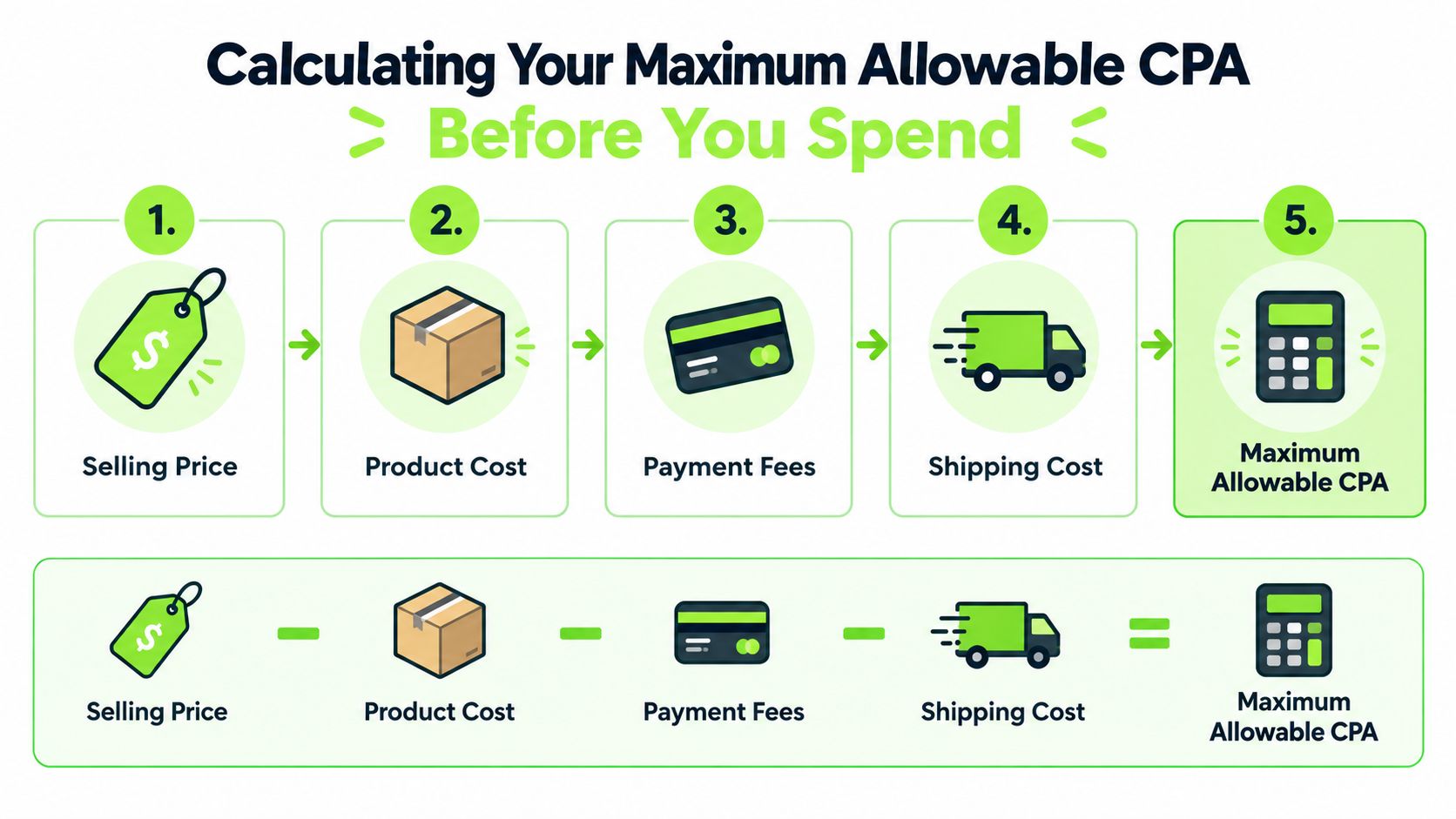
Maximum allowable CPA = selling price − product cost − payment fees − fulfillment and shipping cost − expected refund and support cost − target profit
Product cost reflects the supplier's charge. Payment fees, fulfillment, and shipping reduce the sale proceeds. Expected refund and support costs account for post-purchase expenses, while target profit reserves the amount you intend to keep before acquisition spending.
Turn the formula into a decision
Take the selling price for one order and subtract each cost using your own records or supplier terms. Then subtract your required profit. The remainder is the most you can spend to acquire that order while meeting your target. Record the inputs in a spreadsheet and update them when costs, shipping, or the offer changes.
Compare your ceiling with the $38.19 benchmark CPA. If your ceiling is lower, test whether pricing, shipping, supplier costs, or the offer can improve the economics before raising spend. If it is higher, you have more room to test, but not proof that a campaign will be profitable. Track contribution margin as spend and order volume change.
Reconcile attribution with the store
The benchmark's 1.86x ROAS is platform-reported, so treat it as directional, not as evidence of profit after costs. Compare attributed conversions with store orders, then calculate the contribution margin left after product, fulfillment, acquisition, and post-purchase expenses. Use attribution to spot patterns; scale only when the store's order economics support it.
Comparing Meta, TikTok, and Google for Dropshipping Campaigns
Channel choice shouldn't come from a slogan about impulse products or high-intent search. It should follow the product category, the creative you can make, the point in the customer journey you need to influence, and the quality of your measurement.
A 2025 report found that TikTok was used by 44% of advertisers in Q1 2025, up from 32% a year earlier. In the same period, Meta Advantage+ Shopping grew 82% and Google Performance Max grew 115%. Another 2025 benchmark covering $2.9 billion in spend reported that Meta CPMs rose 26% year over year, while TikTok CPMs fell 25%, with TikTok conversion rates improving. The Q1 channel report and these cost trends can inform a test, but they don't decide whether your product will convert.
Choose a channel by the job it needs to do
For a product that needs a visual demonstration or a clear before-and-after story, test whether short-form social creative can make the value obvious. If your product is commonly searched for by name or solves a problem people actively look up, test a search-oriented route. Meta can be a candidate when your offer benefits from social creative and audience discovery. None of those are fixed rules: product fit and execution still determine whether traffic turns into orders.
Cheaper reach isn't automatically better economics. TikTok performance varies by product fit, and broader ecommerce data found 234% ROAS differences between industries. Use the TikTok ad research guide to study creative approaches, then compare channels using your store's contribution margin rather than a platform's reported ROAS alone.
| Channel | Cost Trend | Creative Volume Needed | Best Funnel Stage | Measurement Quality |
|---|---|---|---|---|
| Meta | CPMs rose 26% year over year in the cited 2025 benchmark | Maintain a varied set of product angles and formats to test | Discovery and conversion, depending on campaign setup | Platform attribution needs reconciliation with store orders |
| TikTok | CPMs fell 25% year over year in the cited 2025 benchmark | Strong need for varied, native-feeling demonstrations and hooks | Discovery and demand creation | Compare attributed orders with store results and margin |
| Performance Max grew 115% in the cited 2025 report; this is not a CPM trend | Product and landing-page assets must support the campaign | Search-led consideration and conversion | Evaluate store orders and contribution margin alongside platform reporting |
Treat the table as a test-selection aid, not a ranking. Begin where your product's discovery behavior and available creative fit best. Expand only when the same offer can withstand a blended review of acquisition cost and post-purchase economics.
Creative Elements That Move Dropshipping Ad Performance
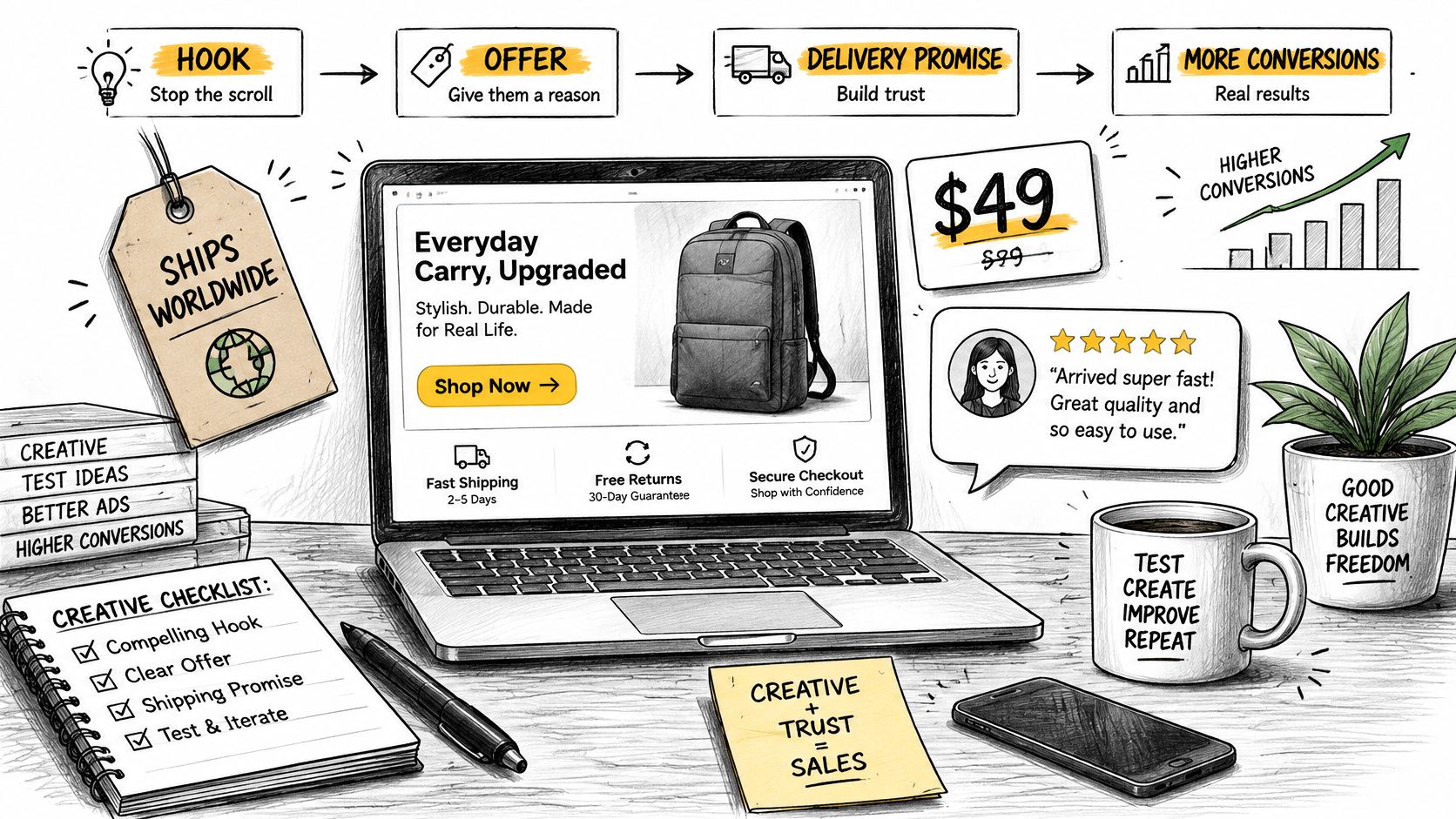
Shipping belongs in the advertising conversation because shoppers can reject an order before checkout when the total cost or delivery promise doesn't work. Ecommerce research citing Baymard-related evidence reports that 39% of shoppers abandon because extra costs such as shipping, taxes, or fees are too high, while 21% abandon because delivery is too slow. The shipping and conversion research helps explain why an ad's promise and a supplier's actual performance have to match.
The chain is direct: uncertain fulfillment can weaken checkout completion, which lowers conversion and increases effective CPA even if CPM and CTR stay the same. A compelling video can earn the click, but it can't make an unaffordable shipping charge or an unrealistic delivery estimate disappear.
Make the creative and customer promise agree
A strong creative should show the product doing the job it claims to do. Start with a hook that names a problem or use case, demonstrate the product clearly, and carry the same benefit into the landing page. If the ad shows one product configuration but the page emphasizes another, the customer has to resolve that mismatch before buying.
Delivery claims need the same scrutiny as product claims. State a country-specific delivery window only when the supplier can consistently meet it. Disclose total landed cost before checkout, and route customers to inventory with predictable tracking. Don't use vague “fast shipping” language to paper over an uncertain fulfillment setup.
Compare conversion rate and CPA by promised delivery band, destination, and product. Then compare like with like by controlling for device and offer.
A faster fulfillment option can be economically superior even when its per-order cost is higher, if its conversion improvement exceeds the incremental shipping cost divided by order value. That's a testable trade-off, not a reason to promise speed before verifying the supplier. Unsupported delivery claims can lead to refunds, chargebacks, negative reviews, and weaker future ad efficiency.
Reading Competitor Ads Without Fooling Yourself
A competitor's long-running ad doesn't prove the campaign is profitable. The advertisement may serve retargeting, target a particular geography, come from catalog automation, or support a low-margin acquisition strategy. An ad library can show activity and creative details; it can't tell you the advertiser's profit from that activity.
Interpretation gets harder as inventory and campaign automation change what platform metrics represent. Meta impressions increased 17% year over year in Q4 2025 while CPM declined 7%, partly as lower-cost Reels inventory expanded. During the 2025 Cyber Five period, Advantage+ accounted for 33% of Meta retail and ecommerce spend, up from 26% in 2024. The Q4 digital ads benchmark shows why more impressions or a lower CPM may reflect inventory mix, not stronger buyer intent.
Triangulate before drawing a conclusion
Start by separating creative survival from profitability. An ad that remains visible tells you it has stayed active, not what it earned. Inspect the landing page, product presentation, price, delivery promise, and checkout experience. Ask whether the offer could support profitable acquisition under your own cost structure.
Then compare what you observe with your own results. Use platform ROAS as directional evidence, reconcile attributed revenue against store-level orders, and judge scale using post-purchase contribution margin. If a competitor's ad suggests a useful hook or product angle, turn it into a test rather than a template to copy.
For a more targeted review, advanced Facebook ad search techniques can help narrow the ads you investigate. Add a confidence label to every conclusion. “The brand is advertising this product” is a direct observation; “the campaign is profitable” is a claim you can't verify from ad longevity alone.
Choosing How to Research Competitor Advertising
The right research process depends on how many stores you track and how often you need to revisit what you find. Manual browsing, a spreadsheet, and a consolidated platform each answer different operational needs. None replaces checking your own order economics.
| Approach | Useful for | Main limitation |
|---|---|---|
| Manual Meta Ad Library browsing | Focused searches and direct inspection of public Meta ads | Repeated checks and notes can become fragmented |
| Spreadsheet tracking | Teams that want a simple record of saved ads, stores, and observations | People must maintain the records and revisit each source |
| Consolidated research platform | Researchers comparing stores, ads, traffic, products, and changes in one workspace | Coverage depends on the platform's data sources and scope |
For manual work, save the ad, landing page, and your reason for tracking it. A spreadsheet adds a shared record, but it depends on someone keeping it current. AdLibrarySpy is a free ecommerce intelligence platform that combines store discovery, traffic data, advertising records, product information, and collaborative research tools in a searchable workspace. The site reports an index of 14.7 million stores.
Check the coverage before you rely on it
Its library searches Facebook and Instagram creatives by brand, niche, format, placement, and country. Records include ad copy, landing pages, run dates, and related advertisements from the same brand. Store profiles bring together traffic history, visitor countries, advertising activity over time, products, applications, and similar shops. Brandtracker records snapshots and sends email notifications about changes, while team workspaces support shared saved stores, ads, folders, and tracked brands.
The limits matter: advertising coverage is restricted to Meta, so TikTok and Google ads aren't included. The platform doesn't provide modelled revenue, advertising spend, or rating figures. Its listed features are free, registration uses an emailed six-digit code instead of a password, and no payment card is required. Choose the approach that fits your monitoring workload, but treat any tool's records as research evidence, not proof of another store's profitability.
Your First Week of Drop Shipping Advertising
A first week produces usable evidence only if the test stays narrow enough to interpret. Pick one product, calculate its maximum allowable CPA, choose a single channel based on how buyers in that category discover products, and build creative around a delivery promise the supplier can keep. Judge every result against contribution margin rather than the ROAS figure the ad manager reports.
Structure the week as a sequence:
- Day one, set the ceiling: Record selling price, product cost, payment fees, shipping, expected refunds and support time, and the profit required per order. The gap between price and costs is the ceiling CPA.
- Day two, pick the channel: Match the product and your available creative assets to one likely discovery route.
- Days three and four, build the test: Produce several distinct ad angles, keep the landing page aligned with each claim, and state delivery terms openly.
- Days five through seven, launch and read: Segment early results by destination, product, and promised delivery band instead of averaging everything together.
Expect the first test to land below your margin threshold. The benchmark economics cited earlier leave thin room for error, so a miss is evidence about the offer or creative, not a verdict on the business. Change one variable at a time, and label anything borrowed from competitor research as observation, hypothesis, or unverified claim before it shapes a decision.
AdLibrarySpy provides a searchable workspace for gathering creative and offer hypotheses ahead of a drop shipping advertising test. Validate each one against your own order and cost records before committing more spend.
More guides
Try AdLibrarySpy free
Search millions of stores and real Meta ads. No card, no trial — sign up with just your email.